
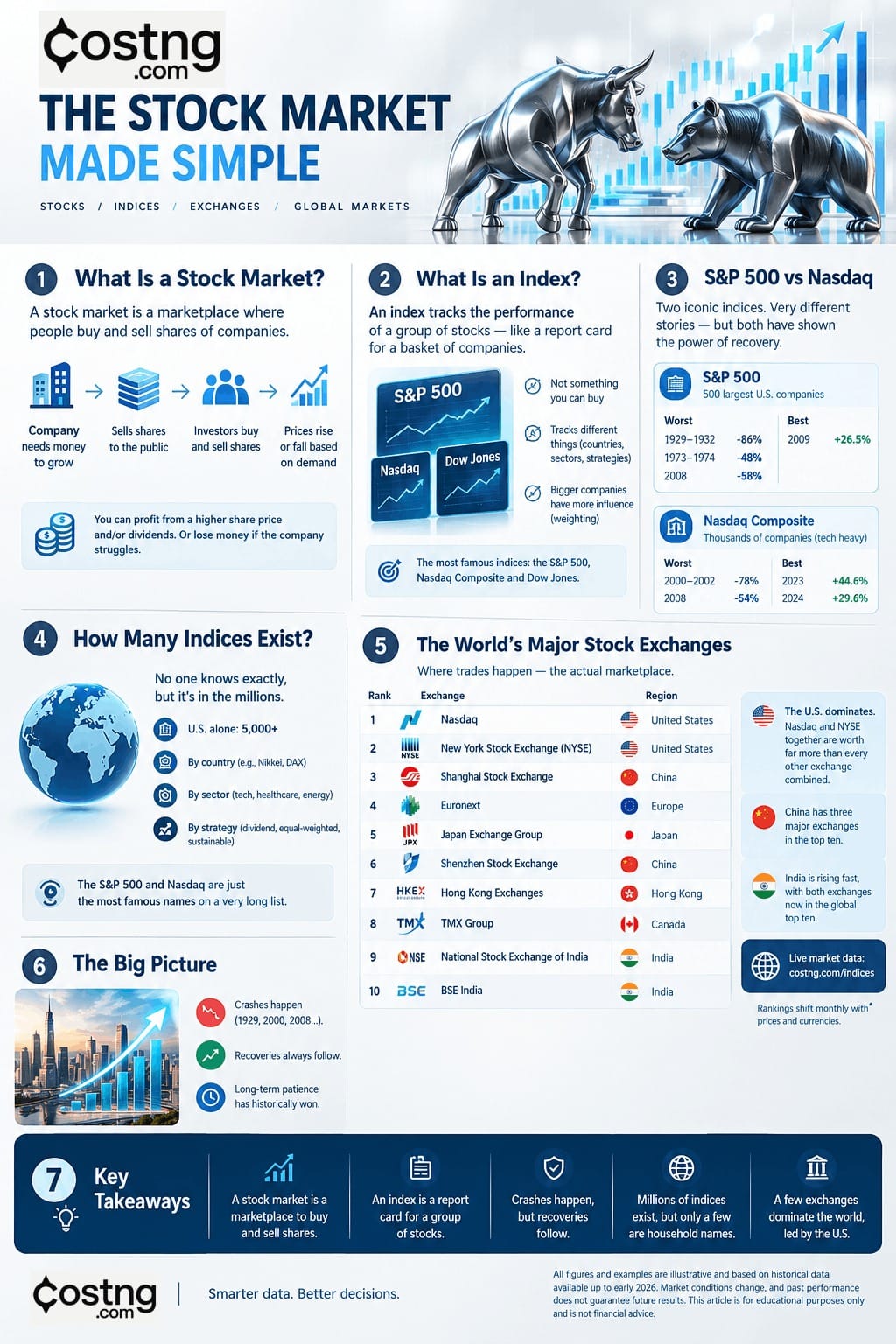
You hear about "the market" every single day. It's up, it's down, it's crashing, it's rallying. But what does any of that actually mean?
If you've ever nodded along to a financial headline without really understanding it, this article is for you. By the end, you'll know what a stock market is, what an index is, which exchanges matter most, and how the two most famous market measures in the world — the S&P 500 and the Nasdaq — have performed over the last century.
No jargon. No finance degree required. Let's start simple.
What Is a Stock Market?
Imagine eBay. Sellers list items. Buyers browse, bid, and make offers. Prices go up when something is in demand and down when it isn't. Trades happen all day long, and both sides meet in one central place.
A stock market works almost exactly the same way — except the "items" being traded are shares of companies.
Here's the basic idea:
- A company wants to grow but needs money. So it splits ownership into tiny pieces called shares and sells them to the public.
- Investors buy those shares, hoping the company will do well and the share price will rise.
- If the company prospers, shareholders can profit two ways: the share price goes up, and/or the company pays out a portion of its profits, called dividends.
- If the company struggles, the share price falls — and investors can lose money.
Just like an online marketplace, prices move both ways, every second, based on supply and demand. When more people want to buy a stock than sell it, the price rises. When more want to sell than buy, it falls.
That's the stock market in one sentence: a continuous marketplace where people buy and sell small pieces of companies.
What Is an Index?
Now here's the problem: there are thousands of stocks. You can't watch them all at once. That's where an index comes in.
An index is a single number that tracks the performance of a group of stocks. Think of it as a report card for a basket of companies rather than for just one.
Instead of checking 500 individual stock prices, you check one number that represents all of them. When someone says "the market was up today," they almost always mean a major index rose.
A few things to know:
- An index is not something you can buy. It's just a measuring tool.
- Different indices track different things. Some follow large companies, some follow tech companies, some follow a whole country.
- Weighting matters. In many indices, bigger companies have more influence. A 1% move in a giant company shifts the index more than a 1% move in a small one.
The three most famous indices are the S&P 500, the Nasdaq Composite, and the Dow Jones. We'll focus on the first two.
The S&P 500 and Nasdaq: Best and Worst Periods
The S&P 500 tracks 500 of the largest U.S. companies. The Nasdaq Composite tracks thousands of companies listed on the Nasdaq exchange and leans heavily toward technology.
Both have seen spectacular highs — and brutal lows.
The Worst of Times
S&P 500 — The Great Depression (1929–1932). This remains the darkest chapter in market history. The index fell about 86% from its 1929 peak to its 1932 bottom. It took until 1954 — roughly 25 years — to fully recover. Other painful periods include the 1973–1974 bear market (-48%) and the 2008 financial crisis (-58%).
Nasdaq — The Dot-Com Crash (2000–2002). When the technology bubble burst, the Nasdaq lost about 78% of its value. It took roughly 15 years to climb back to its previous high. The 2008 crisis also cut the Nasdaq by about 54%.
The Best of Times
Markets don't stay down forever. Recent years show how powerful recoveries can be:
- The Nasdaq surged 44.6% in 2023 and 29.6% in 2024.
- The S&P 500 returned 26.5% in 2009, bouncing back from the financial crisis.
The Lesson
Crashes are a recurring feature of the stock market. They're triggered by wars, recessions, bubbles, and panics. But here's the pattern history keeps repeating: every major crash has eventually been followed by a recovery. Investors who panicked and sold at the bottom locked in their losses. Those who stayed patient were rewarded.
How Many Indices Exist?
Here's a number that surprises almost everyone: no one knows exactly, but it's in the millions.
Major index providers publish hundreds of thousands of indices, and when you count every index calculated daily around the world, the total reaches millions. The United States alone has more than 5,000 indices.
Why so many? Because indices can be customized to track almost anything:
- By country — like Japan's Nikkei or Germany's DAX
- By sector — technology, healthcare, energy
- By strategy — dividend-focused, equal-weighted, sustainable
The S&P 500 and Nasdaq are simply the most famous names on a very long list.
The World's Major Stock Exchanges
An exchange is the actual marketplace where trades happen — the platform, like eBay itself. Here are the biggest by size (total value of companies listed):
| Rank | Exchange | Region |
|---|---|---|
| 1 | Nasdaq | United States |
| 2 | New York Stock Exchange (NYSE) | United States |
| 3 | Shanghai Stock Exchange | China |
| 4 | Euronext | Europe |
| 5 | Japan Exchange Group | Japan |
| 6 | Shenzhen Stock Exchange | China |
| 7 | Hong Kong Exchanges | Hong Kong |
| 8 | TMX Group | Canada |
| 9 | National Stock Exchange of India | India |
| 10 | BSE India | India |
A few simple observations:
- The U.S. dominates. Nasdaq and NYSE together are worth far more than every other exchange combined.
- China has three major exchanges in the top ten.
- India is rising fast, with both of its exchanges now in the global top ten.
(Note: rankings shift monthly with prices and currencies, so treat this as a snapshot.)
Key Takeaways
- A stock market is a continuous marketplace where people buy and sell shares of companies — like an online marketplace, but for ownership.
- An index is a report card for a group of stocks, rolled into one number. You can't buy an index itself, but you can buy funds that track it.
- History is full of crashes — 1929, 2000, 2008 — but also full of recoveries. Long-term patience has always won.
- Millions of indices exist, but only a handful are household names.
- A few exchanges dominate the world, led overwhelmingly by the United States.
Next time you see a headline about the market, you'll know exactly what it means — and that's a real advantage.