
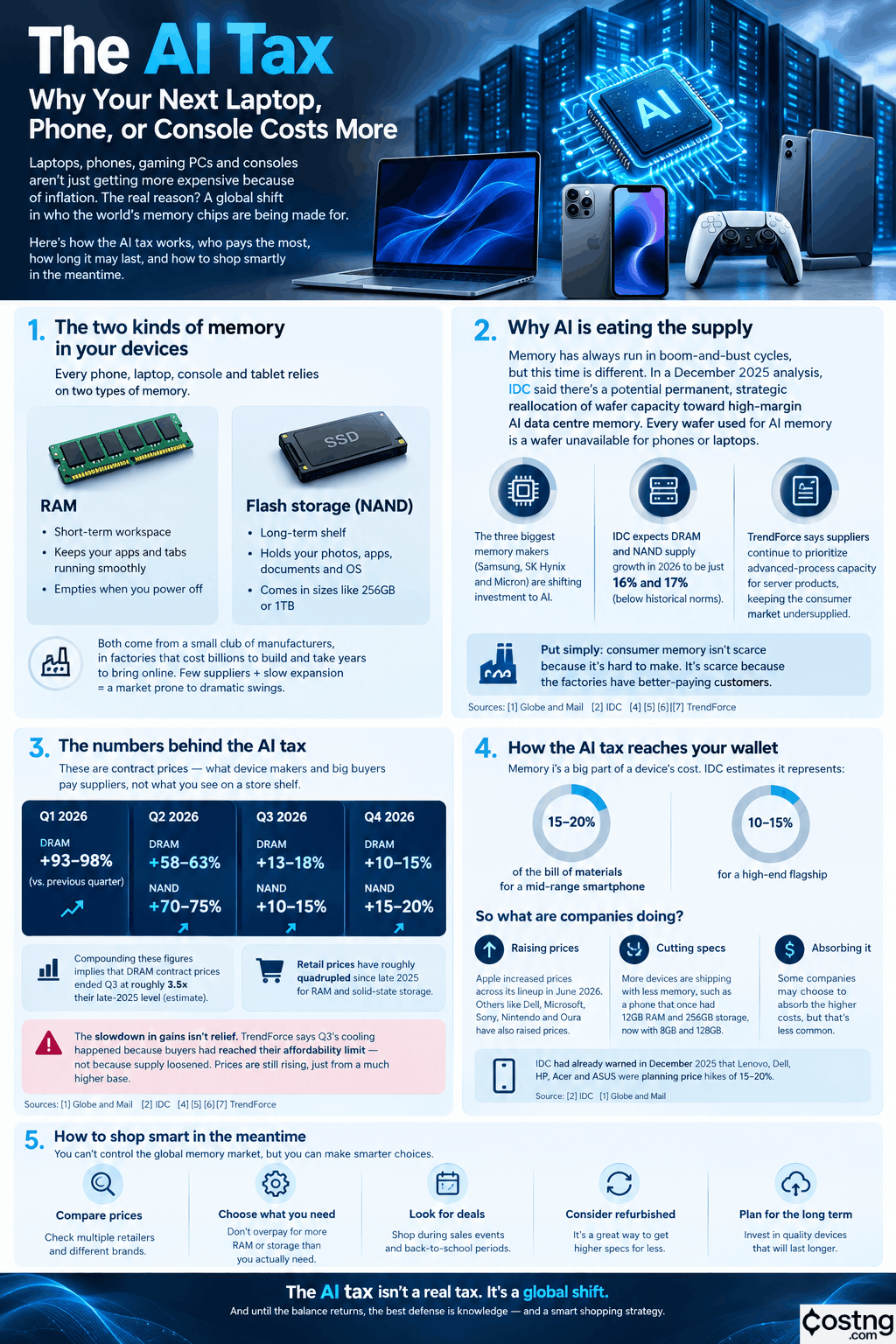
Somewhere in the last year, shopping for electronics got strange. Laptops that should have been getting cheaper held their price or crept up. Gaming PCs came with surprising markups. Phone upgrades started to feel less like treats and more like budget meetings.
If you've noticed, you're right. The cause is a shift in who the world's memory chips are being made for. Kevin Jia, CEO of the Toronto PC builder Quoted Tech, has a name for the resulting price hikes: an "AI tax" [1]. It isn't a real tax, of course. It's a hidden surcharge that everyday buyers pay whether or not they ever open a chatbot.
Here's how the AI tax works, who pays the most, how long it may last, and how to shop smartly in the meantime.
The two kinds of memory in your devices
Every phone, laptop, console, and tablet relies on two types of memory.
RAM is the short-term workspace. It lets your device keep dozens of browser tabs open, edit a video, or render a game without stuttering. When you power off, it empties.
Flash storage (NAND) is the long-term shelf. It holds your photos, apps, documents, and operating system, and it's what you're choosing when you pick a 256-gigabyte model over a 1-terabyte one.
Both come from a small club of manufacturers, in factories that cost billions to build and take years to bring online. Few suppliers plus slow expansion makes the memory market prone to dramatic swings.
Why AI is eating the supply
Memory has always run in boom-and-bust cycles, but IDC's analysts argue this one is different. In a December 2025 analysis, they described a potentially permanent, strategic reallocation of the world's silicon wafer capacity rather than an ordinary cyclical shortage [2]. The three biggest memory makers (Samsung, SK Hynix, and Micron) have shifted cleanroom space and investment toward high-margin memory for AI data centres, and IDC calls it a zero-sum game: every wafer used for a stack of AI memory is a wafer unavailable for a phone or a laptop SSD. IDC expected DRAM and NAND supply growth in 2026 to come in at only 16% and 17% respectively, below historical norms [2].
TrendForce, the memory-market research firm, describes the same dynamic in every one of its quarterly price updates. In its fourth-quarter outlook, it says suppliers continue to give priority to advanced-process capacity for high-performance server products, which keeps the overall market undersupplied [7]. Micron, one of the big three, went as far as closing its consumer-facing brand in December 2025, according to the Globe and Mail's reporting [1].
Put simply, consumer memory isn't scarce because it's hard to make. It's scarce because the factories have better-paying customers.
The numbers behind the AI tax
The price movements are without recent precedent. These are contract prices, which are what device makers and big buyers pay suppliers, not what you see on a store shelf:
- Q1 2026: Conventional DRAM contract prices rose roughly 93–98% over the previous quarter, according to TrendForce's finalized survey [4].
- Q2 2026: TrendForce projected a further 58–63% rise in conventional DRAM and a 70–75% rise in NAND flash [4][5].
- Q3 2026: Gains slowed to a forecast 13–18% for DRAM and 10–15% for NAND [6].
- Q4 2026: TrendForce forecasts another 10–15% for conventional DRAM and 15–20% for NAND [7].
Compounding those quarterly figures implies that conventional DRAM contract prices ended the third quarter at roughly three and a half times their late-2025 level. (That's the author's own arithmetic, combining actual and forecast figures, so treat it as an estimate.)
Retail prices tell a similar story. The Globe reported that the retail price of RAM and solid-state storage has roughly quadrupled since late 2025 [1].
The slowdown in percentage gains shouldn't be mistaken for relief. TrendForce says the Q3 cooling happened because consumer-market buyers, such as PC and smartphone makers, had reached their affordability limit at record-high prices, not because supply loosened [6]. Prices are still rising, just from a much higher base.
How the AI tax reaches your wallet
Memory is one component among many in a device, but it's a big one. IDC estimates that memory represents 15–20% of the bill of materials for a mid-range smartphone and 10–15% for a high-end flagship [2]. When a cost that large jumps, device makers have three unappealing choices: absorb it, raise prices, or cut specs.
Many are doing the second. According to the Globe, Apple raised prices across its lineup in late June 2026. The Neo laptop went from US$599 to US$699, the MacBook Air from US$1,099 to US$1,299, and the iPad Air from US$599 to US$749. Dell, Microsoft, Motorola, Sony, Nintendo, and Oura have raised prices too [1]. IDC had already reported in December that Lenovo, Dell, HP, Acer, and ASUS were warning customers of price hikes in the 15–20% range [2].
Others are doing the third. IDC expects more devices to ship with less memory, offering the example of a phone that would once have launched with 12GB of RAM and 256GB of storage now debuting with 8GB and 128GB at the same price [3]. That kind of quiet downgrade is easy to miss unless you read the spec sheet.
What it's doing to sales
When devices cost more, people buy fewer of them. IDC's February forecast projected global PC shipments falling 11.3% in 2026 and smartphone shipments falling 12.9%. Because prices are rising, though, it expects PC industry revenue to still grow by 1.6% [3]. Fewer machines are being sold, but each one costs more.
IDC also sees the effects lasting. It expects memory supply challenges to persist through 2026 and likely well into 2027, and says its model doesn't point to a return to 2025 pricing within its forecast period [3].
Who pays the most
Budget buyers. IDC warns that the math doesn't work for a $150 smartphone or a $400 laptop when memory costs surge by double or triple digits in a quarter. More than 360 million smartphones shipped below $150 last year, and IDC expects many vendors to leave those price points or ship noticeably weaker products at higher prices [3].
DIY PC builders. For years, building your own gaming PC was a way to save money. IDC noted in December that white-box and smaller vendors, including DIY systems often built by gamers, would carry some of the heaviest burden, while big manufacturers could gain share by positioning pre-built systems as better value [2]. The Globe's reporting on Canadian builders points the same way: people who once saved a couple of hundred dollars by building their own are now reconsidering [1].
Smaller device makers. Companies with less purchasing power struggle to secure memory at all. IDC expects market share to shift toward the largest manufacturers, who can lock in supply with large-volume contracts [3].
When does it end?
Nobody knows for certain, but few forecasters expect quick relief. IDC's February outlook has the PC market flattening in 2027 with a rebound pushed to 2028, and smartphones growing a modest 1.9% in 2027 before a stronger 5.2% rebound in 2028 [3]. Harvard Business School professor Willy Shih told the Globe that new memory factories take about two years to come online, so added capacity won't arrive quickly [1].
There's a wildcard too. A sharp cooling in AI spending could change the picture fast, since the same forces that created the squeeze could unwind in reverse. But that's a risk to watch rather than a plan to build around.
A bigger worry: owning versus renting
One more consequence deserves attention. When buying powerful hardware gets expensive, subscriptions look more attractive: cloud storage instead of your own drives, streamed games instead of a gaming PC. One Newfoundland hobbyist told the Globe he worries consumers are gradually losing ownership of the things they pay for, as hardware prices push people toward renting [1].
Renting can make sense, but it means ongoing fees and less control over your data and your tools. Add up the multi-year cost before deciding.
Smart ways to shop in a squeezed market
- Extend what you have. If your device works, the cheapest option may be to keep using it. Clear out unused files, update your software, and replace a worn battery instead of the whole device.
- Match memory to your real needs. Browsing, streaming, and office work don't need the biggest configuration. Video editors, developers, and serious gamers may need more, but be honest about which group you're in.
- Prioritize upgradeability. If memory can be added later, you can start modestly and expand when prices ease. Many thin laptops solder memory in place, so check before you buy.
- Read the spec sheet. Given the downgrade trend IDC describes, compare RAM and storage between this year's model and last year's, not just the price.
- Consider refurbished and open-box. Certified refurbished devices often come with warranties and cost noticeably less. Stick to reputable sellers with clear return policies.
- Be careful with used parts. Secondhand components can offer relief, but misdescribed listings and scams are common when prices are high. Use platforms with buyer protection and be skeptical of deals that look too good.
- Don't panic buy, but don't wait for a crash either. Fear of further increases can push people to overspend. At the same time, with analysts not expecting a return to 2025 pricing soon, holding out for one is a risky strategy if you genuinely need a new device.
- Set price alerts. Prices move in waves, and holiday promotions can create short windows of relief. An alert on the specific model you want costs nothing.
The bottom line
For decades, consumer electronics set the pace for the chip industry. Now a new class of customer has arrived with deeper pockets and a seemingly bottomless appetite, and the industry is reorienting around it. That doesn't make anyone a villain. Companies follow demand, and AI infrastructure is a legitimate and enormous source of it. But it does mean ordinary buyers can no longer assume electronics will get cheaper every year.
The AI tax is real, even if no one ever sends you a bill for it. Understanding where it comes from is the first step to paying less of it.
References
- Rolfe, Kelsey. "An 'AI tax' is driving up the price of gaming computers and other electronics." The Globe and Mail, August 3, 2026 (updated August 4, 2026). (Add the article URL here before publishing.)
- Jeronimo, F., Mainelli, T., Ma, B., Reith, R., and Janukowicz, J. "Global Memory Shortage Crisis: Market Analysis and the Potential Impact on the Smartphone and PC Markets in 2026." IDC, December 18, 2025. https://www.idc.com/resource-center/blog/global-memory-shortage-crisis-market-analysis-and-the-potential-impact-on-the-smartphone-and-pc-markets-in-2026/
- Popal, N., Reith, R., Janukowicz, J., Mainelli, T., Jeronimo, F., and Ma, B. "Higher ASPs, lower unit volumes: How the memory crisis is reshaping the PC and smartphone outlook." IDC, February 26, 2026. https://www.idc.com/resource-center/blog/higher-asps-lower-unit-volumes-how-the-memory-crisis-is-reshaping-the-pc-and-smartphone-outlook
- TrendForce. "Rapid Contract Price Surge Drives 1Q26 DRAM Industry Up 81% QoQ, Says TrendForce." Press release, June 1, 2026. https://www.trendforce.com/presscenter/news/20260601-13070.html
- TrendForce. "AI Server Demand to Drive Memory Contract Price Increases in 2Q26 as CSPs Secure Supply via Long-Term Agreements." Press release, March 31, 2026 (English text as reprinted by iConnect007). https://iconnect007.com/article/149414/ai-server-demand-to-drive-memory-contract-price-increases-in-2q26-as-csps-secure-supply-via-longterm-agreements/149411/pcb
- TrendForce. "AI Server Demand Continues to Support Memory Prices in 3Q26, but Gains Moderate as Consumer Demand Weakens and High Base Effects Take Hold." Press release, July 3, 2026. https://www.trendforce.com/presscenter/news/20260703-13134.html
- TrendForce. "AI Server Demand Sustains Memory Contract Price Increases in 4Q26, While Consumer-Side Pressure Persists." Press release, September 30, 2026. https://www.trendforce.com/presscenter/news/20260930-13258.html