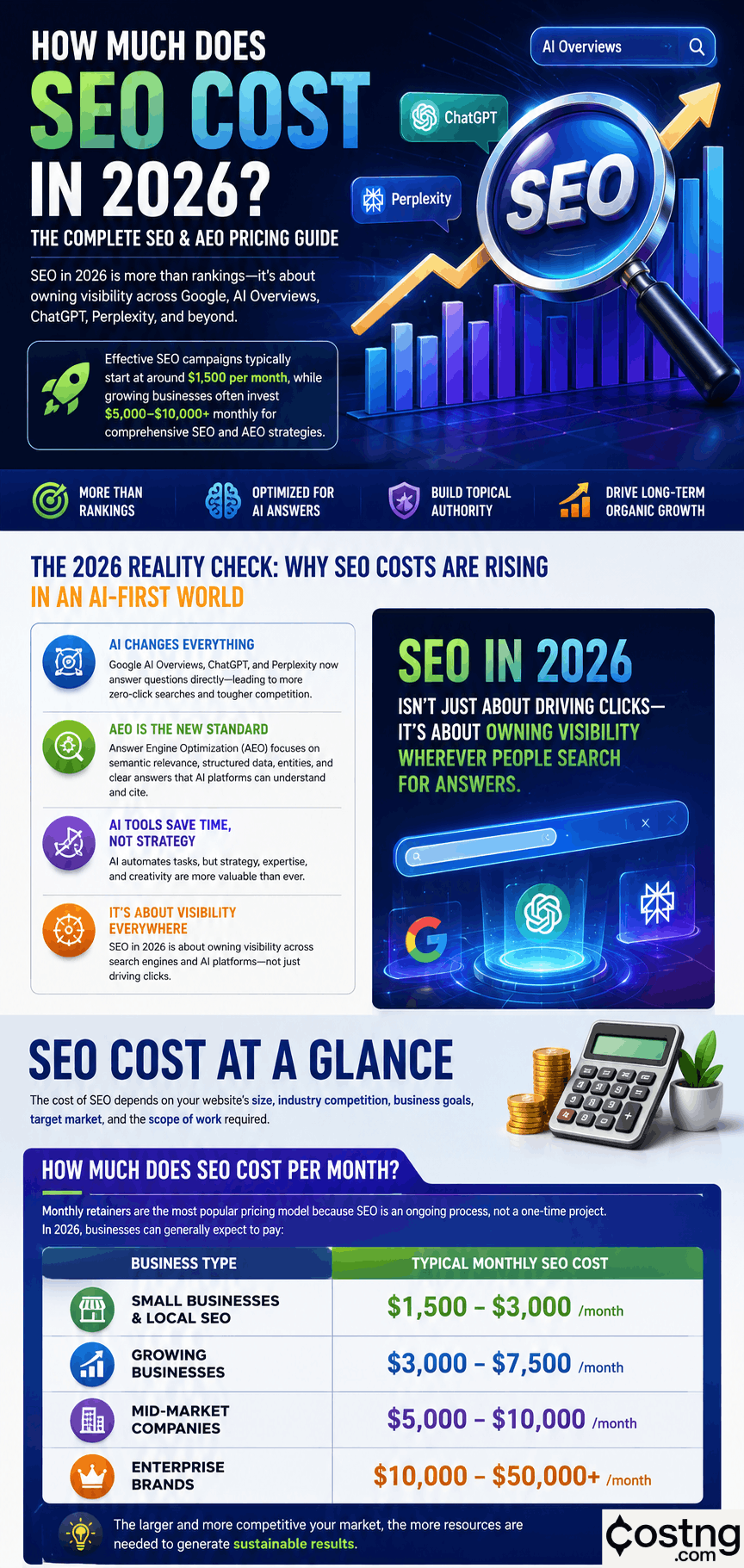
If you're wondering how much SEO costs in 2026, the answer depends on more than your business size or industry. Today's search landscape has evolved beyond traditional Google rankings.
With the rise of Google AI Overviews, ChatGPT, Perplexity, and other AI-powered search engines, businesses must now optimize for both Search Engine Optimization (SEO) and Answer Engine Optimization (AEO). This shift requires stronger technical foundations, semantic content, structured data, and topical authority - making modern SEO more strategic than ever.
While AI has reduced the cost of repetitive tasks, it has also increased the demand for experienced SEO professionals who can build long-term organic visibility. As a result, effective SEO campaigns typically start at around $1,500 per month, while growing businesses often invest $5,000–$10,000+ monthly for comprehensive SEO and AEO strategies.
In this guide, you'll learn what SEO costs in 2026 (all prices in $USD), the factors that influence pricing, different pricing models, and how to choose the right investment for your business.
The 2026 Reality Check: Why SEO Costs Are Rising in an AI-First World
SEO has changed dramatically. Ranking on Google is no longer enough.
Today, Google increasingly answers users' questions through AI Overviews, while platforms like ChatGPT and Perplexity deliver direct answers without requiring users to visit websites. This rise of zero-click searches means businesses must compete not only for rankings but also to become trusted sources that AI platforms cite.
That's why modern SEO now includes Answer Engine Optimization (AEO) - optimizing content with semantic relevance, structured data, entities, and clear answers that AI systems can easily understand.
Although AI tools have made some SEO tasks faster, they haven't replaced strategy. Businesses now invest more in technical SEO, topical authority, high-quality content, and digital PR to maintain visibility across both search engines and AI platforms. In 2026, SEO isn't just about driving clicks - it's about owning visibility wherever people search for answers.
SEO Cost at a Glance
By now, it's clear that SEO isn't a one-size-fits-all service and neither is its pricing.
The cost of SEO depends on factors like your website's size, industry competition, business goals, target market, and the scope of work required. A local business looking to rank in one city will invest far less than an enterprise brand competing nationally or globally.
Below is a quick overview of what businesses typically pay for SEO and AEO services in 2026.
How Much Does SEO Cost Per Month?
Monthly retainers remain the most popular pricing model because SEO is an ongoing process, not a one-time project. Most agencies provide continuous technical optimization, content creation, link building, reporting, and strategy under a monthly retainer.
In 2026, businesses can generally expect to pay:
| Business Type | Typical Monthly SEO Cost |
|---|---|
| Small Businesses & Local SEO | $1,500–$3,000/month |
| Growing Businesses | $3,000–$7,500/month |
| Mid-Market Companies | $5,000–$10,000/month |
| Enterprise Brands | $10,000–$50,000+/month |
The larger and more competitive your market, the more resources are needed to generate sustainable results.
How Much Does SEO Cost Per Hour?
Hourly pricing is common for SEO consultants, technical audits, strategy sessions, and one-off consulting projects.
Agency rates in North America typically range between $100–$149 per hour, while consultants and agencies in lower-cost regions may charge significantly less depending on experience and location.
Hourly pricing works well when you need expert guidance or a specific SEO task rather than ongoing campaign management.
How Much Does an SEO Project Cost?
Project-based SEO is ideal for businesses that need a clearly defined deliverable, such as a website migration, technical audit, content strategy, or SEO overhaul.
Most SEO projects in 2026 fall between $5,000 and $30,000, although larger enterprise initiatives can exceed this range depending on complexity and website size.
Unlike monthly retainers, project pricing covers a fixed scope of work with a defined start and finish.
How Much Does AEO Cost?
Answer Engine Optimization (AEO) is still an emerging service, so there isn't a universal pricing standard yet.
Rather than charging separately, many agencies now bundle AEO into their SEO retainers by incorporating AI-ready content, structured data, semantic optimization, entity building, and featured snippet optimization. Businesses looking for dedicated AI visibility strategies should generally expect to invest at least as much as a traditional SEO campaign, with pricing increasing based on the depth of optimization required.
Why There Is No Single "Average" SEO Price
If you've searched for the average cost of SEO, you've probably found conflicting numbers — and for good reason.
SEO pricing varies because every business has different goals, competition levels, website sizes, and growth ambitions. A local service business may only need a modest monthly investment, while an enterprise brand competing in industries like finance, legal, or healthcare may require a significantly larger budget.
Instead of asking, "What's the average SEO price?", ask "What level of investment does my business need to achieve its goals?"
The answer depends on the strategy, expertise, and resources required—not a single industry-wide average.
What Does SEO Cost Actually Pay For?
Many businesses assume they're paying for a few keywords, blog posts, or backlinks.
In reality, professional SEO is a combination of strategy, technical expertise, content, authority building, and continuous optimization. You're not simply paying for individual tasks—you're investing in a system designed to increase your organic visibility, attract qualified traffic, and generate long-term business growth.
Understanding where your budget goes helps explain why SEO pricing varies so widely between providers.
SEO Is Not One Service
SEO isn't a standalone service - it's a collection of specialized disciplines working together.
A successful SEO campaign may involve technical audits, keyword research, content strategy, on-page optimization, digital PR, link building, analytics, conversion improvements, and ongoing performance monitoring. Removing one of these components often limits the effectiveness of the others.
That's why reputable agencies typically build multidisciplinary teams instead of relying on a single SEO specialist.
The Seven Main Components of SEO Cost
Most SEO investments are distributed across seven core areas.
Strategy and Research
Every successful campaign begins with a solid strategy. This includes business analysis, competitor research, keyword research, search intent analysis, topical mapping, and SEO roadmaps. Without a clear strategy, even the best content and technical improvements are unlikely to produce consistent results.
Technical SEO
Technical SEO ensures search engines can efficiently crawl, understand, and index your website. This includes website audits, Core Web Vitals optimization, schema markup, crawl error fixes, site architecture improvements, mobile optimization, page speed, indexing issues, and other technical enhancements that form the foundation of organic visibility. For most agencies, technical SEO is the first stage of any campaign.
Content
Content remains one of the largest ongoing SEO investments. This covers content planning, writing, editing, optimization, content refreshes, landing pages, blog articles, and topical authority development. Higher-budget SEO campaigns typically produce more high-quality content each month to expand keyword coverage and strengthen expertise within a niche.
On-Page Optimization
Publishing content isn't enough—it must also be optimized. On-page SEO includes optimizing title tags, meta descriptions, heading structure, internal linking, image optimization, semantic keywords, entities, structured content, and user experience signals that help search engines better understand each page.
Authority Building and Digital PR
Google still relies heavily on trust and authority signals. This part of the budget focuses on acquiring high-quality backlinks, digital PR, brand mentions, guest posting, and outreach campaigns that strengthen your website's credibility and improve rankings in competitive industries.
Technology and Tools
Professional SEO requires powerful software for research, monitoring, reporting, and technical analysis. Agencies invest in platforms such as keyword research tools, backlink analysis software, site crawlers, rank tracking systems, analytics dashboards, and AI-powered optimization tools. These subscriptions represent a significant operational cost that's typically included within SEO retainers.
Management and Reporting
SEO is an ongoing process that requires coordination, communication, and continuous refinement. This includes project management, monthly reporting, performance analysis, strategy meetings, KPI tracking, and adjusting campaigns based on algorithm updates and business objectives. Transparent reporting ensures clients understand what has been completed, what's working, and what comes next.
SEO Pricing Models Explained
Once you understand what SEO actually pays for, the next question is how providers charge for it.
In 2026, there are six primary SEO pricing models. Each has different advantages, risks, and use cases depending on your business size, goals, and budget.
Monthly SEO Retainers
Monthly retainers are the most common pricing model because SEO is an ongoing process rather than a one-time task.
A retainer typically includes:
- Technical SEO maintenance
- Content creation and optimization
- Link building and digital PR
- Reporting and analytics
- Strategy updates and competitor monitoring
According to industry research, 61–78% of SEO engagements are structured as monthly retainers, making this the dominant model for long-term growth campaigns.
| Retainer Tier | Typical Monthly Cost |
|---|---|
| Starter / Local SEO | $1,500–$3,000 |
| Small Business Growth | $3,000–$5,000 |
| Mid-Market | $5,000–$10,000 |
| Advanced / National | $7,500–$15,000 |
| Enterprise | $15,000–$50,000+ |
Retainers work best when your goal is consistent traffic growth, lead generation, and long-term market visibility.
Hourly SEO Pricing
Hourly pricing is common for consultants, technical specialists, and advisory engagements.
Typical use cases include:
- SEO audits
- Migration planning
- Strategy workshops
- Training sessions
- Troubleshooting technical issues
North American agencies typically charge $100–$149 per hour, while consultants may charge anywhere from $75 to $250+ per hour depending on expertise.
This model is ideal when you need expert guidance without committing to an ongoing campaign.
Project-Based SEO Pricing
Project pricing is used when the scope has a clear beginning and end.
Common examples include:
- Website migrations
- Technical SEO overhauls
- Content strategy development
- International SEO setup
- Penalty recovery
Most SEO projects in 2026 fall between $5,000 and $30,000, with larger enterprise initiatives exceeding that range.
The advantage is predictability: you know the deliverables, timeline, and total cost upfront.
Performance-Based SEO Pricing
Performance-based SEO ties fees to results such as rankings, traffic, or leads.
Examples include:
- Pay per ranking improvement
- Pay per lead generated
- Revenue-share agreements
While attractive in theory, this model is relatively uncommon among established agencies because search results are influenced by many factors outside the provider's control. A major warning sign is any company that guarantees #1 rankings, which reputable SEO professionals generally avoid.
Fixed-Scope SEO Packages
Many agencies offer packaged SEO plans with predefined deliverables.
Example: Starter Package – $2,000/mo – Technical audit, 4 blog posts, 10 page optimizations, 5 backlinks, monthly report.
Packages simplify purchasing but can become restrictive if your needs change over time.
In-House SEO Teams
Instead of outsourcing, some businesses hire internal SEO staff.
A single in-house SEO specialist in the U.S. typically costs:
| Expense | Annual Cost |
|---|---|
| Salary | ~$70,000 |
| Benefits & taxes | $15,000–$25,000 |
| SEO tools | $3,000–$10,000 |
| Training & conferences | $1,000–$5,000 |
| Total annual investment | $90,000–$120,000+ |
That equates to roughly $7,500–$10,000+ per month, often comparable to hiring a strong SEO agency.
Hybrid SEO Models
Many companies combine multiple approaches:
- In-house marketing team + external SEO agency
- Consultant + freelance writers
- Technical agency + internal content team
Hybrid models can be cost-effective because they allow businesses to keep strategic control while outsourcing specialized execution.
Which SEO Pricing Model Is Right for Your Business?
| Business Situation | Best Pricing Model |
|---|---|
| Local service business | Monthly retainer |
| One-time website redesign | Project-based |
| Need expert guidance | Hourly consultant |
| Large marketing department | Hybrid model |
| Enterprise organization | Agency + in-house team |
| Early-stage startup | Small retainer or consultant |
For most businesses, a monthly retainer remains the safest and most effective option because it aligns with the way SEO compounds over time. Rankings, authority, and organic traffic rarely improve in a straight line - they build gradually through continuous optimization.
The key is not choosing the cheapest pricing model, but choosing the one that provides enough strategic attention, execution capacity, and accountability to achieve your business goals.
How Much Does SEO Cost by Provider?
The cost of SEO depends not only on what services you need but also who delivers them.
A freelance SEO specialist, independent consultant, full-service agency, and enterprise SEO firm all have different pricing structures, team sizes, and levels of expertise. Understanding these differences helps you choose the right partner based on your goals, budget, and growth stage.
How Much Does an SEO Freelancer Cost?
Freelancers are typically the most affordable option for businesses with limited budgets or straightforward SEO needs. According to industry surveys, freelancers charge an average of $1,348 per month for ongoing SEO services, although pricing varies based on experience and scope. Some freelancers also charge hourly rates or fixed project fees.
Freelancers are well-suited for: small business websites, local SEO, keyword research, content optimization, basic technical SEO, small link-building campaigns.
Pros: Lower cost than agencies, flexible engagement, direct communication, good for small projects. Cons: Limited capacity, one person rarely specializes in every SEO discipline, less redundancy if the freelancer becomes unavailable.
How Much Does an SEO Consultant Cost?
SEO consultants focus on strategy rather than day-to-day execution. Most consultants charge hourly, daily, or project-based fees. Depending on experience, hourly rates generally range from $100 to $250+, with highly recognized specialists charging even more.
Businesses usually hire consultants for: SEO strategy, website migrations, technical audits, enterprise SEO planning, team training, recovery after Google algorithm updates.
Unlike agencies, consultants often provide recommendations while your internal marketing or development team handles implementation. This model works well for organizations that already have marketing resources but need experienced strategic direction.
How Much Does an SEO Agency Cost?
SEO agencies remain the most popular choice because they provide a complete team rather than a single specialist. Industry research shows the average agency retainer is approximately $3,209 per month, although actual pricing depends heavily on the campaign scope and competition.
| Business Size | Typical Monthly Investment |
|---|---|
| Local Business | $1,500–$3,000 |
| Small Business | $3,000–$5,000 |
| Mid-Market | $5,000–$10,000 |
| National Campaigns | $7,500–$15,000 |
| Enterprise | $15,000–$50,000+ |
Most agencies provide multiple specialists, including: SEO strategists, technical SEO experts, content writers, editors, digital PR specialists, link building teams, data analysts, account managers. This collaborative approach allows agencies to execute comprehensive campaigns that would be difficult for a single freelancer to manage.
How Much Does an Enterprise SEO Agency Cost?
Enterprise SEO requires significantly more resources than a standard SEO campaign. Large organizations often manage hundreds of thousands of pages, multiple business units, international websites, multiple languages, large development teams, complex CMS platforms, extensive reporting requirements.
Because of this complexity, enterprise SEO retainers commonly range between $15,000 and $50,000+ per month, with some global organizations investing substantially more.
Enterprise engagements often include: dedicated account teams, executive reporting, technical consulting, large-scale content production, international SEO, programmatic SEO, digital PR campaigns, AI search optimization initiatives.
How Much Does an In-House SEO Employee Cost?
Hiring internally gives businesses complete control over their SEO efforts - but it also comes with significant ongoing costs. The average SEO specialist salary in the United States is approximately $70,000 per year, before accounting for benefits, taxes, software, training, and equipment.
| Cost Component | Estimated Annual Cost |
|---|---|
| Salary | ~$70,000 |
| Benefits & Payroll Taxes | $15,000–$25,000 |
| SEO Software | $3,000–$10,000 |
| Training & Certifications | $1,000–$5,000 |
| Equipment & Overhead | Varies |
In practice, the true annual cost of employing a single SEO professional often exceeds $90,000–$120,000. Many businesses also need additional writers, developers, designers, or outreach specialists, increasing costs further.
How Much Does a DIY SEO Strategy Cost?
Many business owners initially attempt to manage SEO themselves. Although DIY SEO avoids agency fees, it still requires investment in: SEO software, educational resources, AI tools, content creation, website development, personal time. The largest hidden cost is opportunity cost. Every hour spent learning technical SEO or fixing website issues is time that isn't spent growing the business.
DIY SEO can work well for: personal blogs, early-stage startups, local businesses with low competition, website owners willing to invest time into learning. However, as competition increases, many businesses eventually transition to professional SEO support.
Freelancer vs Consultant vs Agency vs In-House SEO
Choosing the right provider depends on your objectives, budget, and internal capabilities.
| Provider | Best For | Typical Cost | Advantages | Limitations |
|---|---|---|---|---|
| Freelancer | Small businesses & startups | ~$1,348/month average | Affordable, flexible | Limited capacity and specialization |
| Consultant | Strategy & advisory | $100–$250+/hour | Senior expertise, strategic guidance | Usually doesn't execute implementation |
| SEO Agency | Most growing businesses | $1,500–$15,000+/month | Full-service team, scalable execution | Higher monthly investment |
| Enterprise Agency | Large organizations | $15,000–$50,000+/month | Dedicated teams, enterprise expertise | Significant investment |
| In-House Team | Businesses needing full control | $90,000–$120,000+/year per specialist | Internal collaboration and ownership | High fixed costs and hiring challenges |
Which Provider Offers the Best Value?
There isn't a universally "best" option. Freelancers are ideal for businesses with modest SEO needs and limited budgets. Consultants provide high-level expertise for organizations with internal marketing teams. SEO agencies offer the best balance of strategy, execution, and scalability for most small and mid-sized businesses. Enterprise agencies are built for organizations operating across multiple markets, languages, or business units. In-house teams make sense when SEO is a core business function requiring full-time attention.
Rather than choosing solely based on price, evaluate the provider's experience, team expertise, processes, reporting, and ability to deliver measurable business outcomes. The cheapest option isn't always the most cost-effective, especially in competitive industries where strategic execution can have a significant impact on revenue.
How Much Does SEO Cost by Service?
SEO pricing varies depending on the services included in your campaign. While some businesses only need a technical audit or local SEO, others require ongoing content creation, link building, digital PR, and enterprise-level optimization. Below is a breakdown of the most common SEO services and what they typically involve.
Technical SEO Cost
Technical SEO ensures your website is easy for search engines to crawl, index, and understand. It typically includes site audits, Core Web Vitals optimization, schema markup, crawl error fixes, XML sitemaps, redirects, and site architecture improvements. Smaller websites often require a one-time technical project, while larger websites benefit from ongoing technical optimization as their sites evolve.
SEO Audit Cost
An SEO audit identifies the issues limiting your website's organic performance. It usually covers technical SEO, on-page optimization, content quality, backlinks, keyword opportunities, and competitor analysis. According to industry research, 43% of businesses pay between $101 and $750 for a standard SEO audit, while larger enterprise audits typically cost more due to their complexity.
Keyword Research Cost
Keyword research helps identify the search terms your audience uses throughout the buying journey. A professional keyword research project includes search intent analysis, keyword clustering, competitor research, and prioritization. Most agencies include this within their monthly SEO retainers rather than charging separately.
Topical Map and Content Strategy Cost
A topical map organizes your content into clusters that build topical authority instead of targeting isolated keywords. It includes content planning, entity research, internal linking recommendations, and a publishing roadmap. Investing in a strong content strategy helps improve long-term SEO performance and content efficiency.
SEO Content Cost
SEO content includes blog posts, landing pages, service pages, product descriptions, and content updates. Agencies typically include content production within monthly retainers. Campaigns around $3,000/month often include 4-6 optimized articles, while larger retainers may produce 8-12 pieces of content monthly.
On-Page SEO Cost
On-page SEO optimizes individual pages for search engines and users. This includes title tags, meta descriptions, heading structure, internal linking, image optimization, semantic keywords, schema markup, and user experience improvements. It's usually an ongoing service included in monthly SEO campaigns.
Link Building Cost
Link building improves your website's authority by earning backlinks from relevant, high-quality websites. Services include outreach, guest posting, resource link building, and relationship management. Most agencies build 5-10 quality backlinks per month for smaller campaigns and more for higher-tier retainers.
Digital PR Cost
Digital PR focuses on earning editorial coverage, brand mentions, and authoritative backlinks through media outreach and newsworthy campaigns. Although it requires a higher investment than traditional outreach, it often delivers stronger authority signals and long-term brand visibility.
Local SEO Cost
Local SEO helps businesses rank in local search results and Google's Map Pack. Services typically include Google Business Profile optimization, local citations, review management, location pages, and local keyword targeting. Single-location businesses generally invest $1,500–$3,000 per month, while multi-location campaigns require larger budgets.
Ecommerce SEO Cost
Ecommerce SEO focuses on optimizing category pages, product pages, site architecture, faceted navigation, and structured data. Due to the large number of pages involved, ecommerce SEO generally requires a higher investment. Industry research places typical monthly costs between $500 and $7,500 depending on store size and competition.
Enterprise SEO Cost
Enterprise SEO supports large websites with thousands of pages, multiple stakeholders, and complex technical requirements. Services often include enterprise technical SEO, automation, international SEO, governance, and executive reporting. Enterprise SEO campaigns commonly range from $15,000 to $50,000+ per month.
International SEO Cost
International SEO helps businesses expand into multiple countries and languages. It includes hreflang implementation, multilingual keyword research, localized content strategies, and country-specific technical optimization. Costs increase with each additional market due to the added complexity.
Programmatic SEO Cost
Programmatic SEO uses templates and structured data to generate hundreds or thousands of optimized landing pages at scale. It's commonly used by SaaS platforms, marketplaces, travel websites, and directories. Pricing largely depends on development effort, automation, and content workflows.
SEO Migration Cost
SEO migration protects your organic visibility during website redesigns or platform changes. It includes URL mapping, redirect planning, technical validation, and post-launch monitoring. Since migrations are high-risk projects, they're typically priced separately from ongoing SEO retainers.
Penalty Recovery Cost
Penalty recovery involves identifying and resolving issues that caused ranking or traffic losses. This may include backlink cleanup, technical fixes, content improvements, and manual action support. Costs vary depending on the severity of the issue and the amount of work required.
SEO Reporting and Analytics Cost
Reporting measures the impact of your SEO investment. Most agencies include monthly reporting, keyword tracking, traffic analysis, conversion monitoring, and strategy reviews within their retainers. Enterprise businesses often require custom dashboards and advanced analytics integrations.
How Much Does SEO Cost by Business Type?
There's no universal SEO pricing because every business has different goals, competition levels, and website complexity. A startup validating its product doesn't require the same investment as an enterprise brand competing across multiple countries.
The table below provides a general benchmark for what different business types typically invest in SEO and what those campaigns usually include.
| Business Type | Typical Cost | Primary SEO Focus | Best For |
|---|---|---|---|
| Startup | $1,500–$3,000/m | Technical SEO, keyword research, foundational content | Building brand awareness and generating initial organic traffic |
| Small Business | $1,500–$5,000/m | Local SEO, on-page optimization, content marketing, technical improvements | Businesses looking to generate consistent leads and compete in regional markets |
| Local Business | $1,500–$3,000/m | Google Business Profile optimization, citations, reviews, local landing pages, Map Pack SEO | Service-area businesses targeting one or more local markets |
| Ecommerce | $2,500–$7,500+/m | Product & category page optimization, technical SEO, content, schema, link building | Online stores with growing product catalogs and competitive search markets |
| SaaS | $5,000–$15,000+/m | Product-led content, topical authority, comparison pages, digital PR, technical SEO | High-growth SaaS businesses competing for high-value keywords |
| B2B | $3,000–$10,000/m | Thought leadership, service pages, lead generation content, technical SEO, authority building | Companies with longer sales cycles and high-value leads |
| Publishers & Media | $5,000–$25,000+/m | Editorial SEO, content optimization, internal linking, structured data | Content-driven websites that rely heavily on audience growth |
| Enterprise | $15,000–$50,000+/m | Enterprise technical SEO, international SEO, automation, digital PR, governance, reporting | Large organizations with complex websites and multiple stakeholders |
Key Takeaway: The right SEO budget isn't determined by business size alone—it's driven by your growth objectives, competition, website complexity, and target market. Businesses in highly competitive industries or multiple geographic markets typically require a larger investment than those serving a single location or niche. The goal is to invest enough to execute a strategy that can realistically achieve your business objectives, rather than simply choosing the lowest-priced option.
How Much Does Local SEO Cost?
Local SEO helps businesses improve their visibility in Google Search, Google Maps, and other location-based search results. The cost depends on the number of locations, competition, and the scope of services included.
What Is Included in Local SEO?
| Local SEO Service | What's Included |
|---|---|
| Google Business Profile | Profile optimization, categories, products, Q&A, posts |
| Local Keyword Research | City and service-specific keyword targeting |
| Citation Management | NAP consistency across directories |
| On-Page Local SEO | Location pages, local schema, metadata optimization |
| Review Management | Review generation and response strategy |
| Local Link Building | Local citations, partnerships, and backlinks |
| Reporting | Rankings, Map Pack visibility, traffic, and leads |
Local SEO Cost by Number of Locations
| Locations | Typical Monthly Cost |
|---|---|
| 1 Location | $1,500–$3,000 |
| 2–5 Locations | $3,000–$6,000 |
| 6–20 Locations | $6,000–$12,000 |
| 20+ Locations | $12,000+/month |
Multi-location businesses require separate landing pages, Google Business Profiles, citations, and reporting for each location.
Local SEO Cost by Industry
| Industry | Typical Monthly Cost |
|---|---|
| Restaurants | $1,500–$2,500 |
| Dentists | $2,000–$4,000 |
| HVAC & Plumbing | $2,500–$5,000 |
| Law Firms | $3,000–$8,000 |
| Real Estate | $2,500–$6,000 |
| Medical Practices | $3,000–$7,500 |
Industries with higher competition generally require larger investments in content, authority building, and local optimization.
Local SEO Cost Drivers
| Factor | Impact on Cost |
|---|---|
| Number of Locations | More locations require more optimization |
| Competition | Competitive markets require larger budgets |
| Number of Services | More service pages increase workload |
| Review Management | Ongoing reputation management adds cost |
| Local Content | Additional location content increases investment |
| Link Building | Competitive industries require stronger authority |
DIY Local SEO vs Hiring a Provider
| DIY Local SEO | Professional Local SEO |
|---|---|
| Lower upfront cost | Faster implementation |
| Suitable for small businesses | Access to SEO specialists |
| Time-intensive | Better long-term scalability |
| Limited technical expertise | Ongoing reporting and strategy |
| Slower results | Greater competitive advantage |
How Much Does Ecommerce SEO Cost?
Ecommerce SEO is typically more expensive than traditional SEO because online stores contain hundreds or thousands of pages that require ongoing optimization.
What Makes Ecommerce SEO More Expensive?
| Factor | Reason |
|---|---|
| Large Product Catalogs | Hundreds or thousands of pages to optimize |
| Technical Complexity | Filters, faceted navigation, duplicate content |
| Continuous Updates | Products, pricing, and inventory change regularly |
| Category Optimization | Multiple revenue-driving landing pages |
| Structured Data | Product, review, and pricing schema |
| Higher Competition | Greater need for content and authority building |
Ecommerce SEO Cost by Website Size
| Store Size | Typical Monthly Cost |
|---|---|
| 100–1,000 Products | $4,000–$7,500 |
| 1,000–10,000 Products | $7,500–$15,000 |
| 10,000+ Products | $15,000–$50,000+ |
Shopify SEO Cost
| Business Size | Typical Cost |
|---|---|
| Small Store | $2,000–$4,000 / month |
| Growing Brand | $4,000–$8,000 / month |
| Enterprise Shopify Plus | $10,000+ / month |
WooCommerce SEO Cost
| Business Size | Typical Cost |
|---|---|
| Small Store | $2,000–$4,000 / month |
| Medium Store | $4,000–$7,500 / month |
| Large WooCommerce Store | $7,500–$15,000 / month |
Enterprise Ecommerce SEO Cost
| Website Size | Typical Monthly Investment |
|---|---|
| National Ecommerce | $10,000–$20,000 |
| Large Enterprise | $20,000–$50,000+ |
| Global Ecommerce | $50,000+ / month |
Enterprise ecommerce campaigns often include automation, international SEO, digital PR, and dedicated technical SEO teams.
Ecommerce SEO Cost Components
| SEO Activity | Included Work |
|---|---|
| Technical SEO | Crawlability, indexing, Core Web Vitals |
| Product SEO | Product pages, schema, metadata |
| Category SEO | Collection page optimization |
| Content Marketing | Buying guides, blogs, FAQs |
| Link Building | Digital PR and outreach |
| CRO Support | Improving conversion alongside traffic |
How Much Does Enterprise SEO Cost?
Enterprise SEO supports organizations with large websites, multiple stakeholders, and complex technical requirements. These campaigns require significantly more resources than traditional SEO.
| Reason | Impact |
|---|---|
| Large Websites | Thousands to millions of URLs |
| Multiple Teams | Marketing, development, content, legal |
| Complex CMS | Longer implementation cycles |
| International Markets | Multiple countries and languages |
| Governance | Extensive QA and approval processes |
Enterprise Technical SEO Costs
Typical Services: Large-scale technical audits, Core Web Vitals optimization, log file analysis, crawl budget optimization, indexation management, schema implementation, automation and scripting.
Enterprise Content Costs
Content Investment Typical Focus: High-volume publishing, topic clusters, content refreshes (existing content optimization), editorial workflows (multi-author publishing), AI-assisted content with human review and optimization.
International SEO Costs
Included Services: Hreflang implementation, multilingual keyword research, country-specific content, international technical SEO, local link acquisition.
| Business Size | Typical Monthly Investment |
|---|---|
| Mid-Market Enterprise | $10,000–$20,000 |
| Large Enterprise | $20,000–$50,000 |
| Global Enterprise | $50,000+ / month |
These campaigns typically include dedicated account teams, executive reporting, advanced technical SEO, content operations, and digital PR.
Enterprise SEO Technology Costs
| Technology Category | Typical Annual Cost |
|---|---|
| SEO Platforms | $3,000–$15,000 |
| Enterprise Crawlers | $5,000–$20,000 |
| Rank Tracking | $2,000–$10,000 |
| Content Optimization | $2,000–$12,000 |
| Analytics & BI | $5,000–$25,000 |
Large enterprises often invest tens of thousands of dollars annually in SEO technology alone to support large-scale optimization, reporting, and automation.
How Much Does AEO Cost?
As AI-powered search continues to evolve, businesses are investing in Answer Engine Optimization (AEO) to improve their visibility across platforms like ChatGPT, Google AI Overviews, Perplexity, Microsoft Copilot, and Gemini.
Unlike traditional SEO, AEO is still an emerging service with no standardized pricing. Most agencies offer AEO as an extension of SEO or as a custom consulting engagement, with costs varying based on business size, competition, and implementation requirements.
What Is AEO?
Answer Engine Optimization (AEO) is the practice of optimizing your website and brand so AI-powered search engines can understand, trust, and cite your content when generating answers. Rather than focusing solely on rankings and clicks, AEO aims to increase your brand's visibility within AI-generated responses.
How Is AEO Different From SEO?
| SEO | AEO |
|---|---|
| Optimizes webpages for search rankings | Optimizes content for AI-generated answers |
| Primary goal is organic traffic | Primary goal is AI visibility and citations |
| Targets Google & Bing Search | Targets ChatGPT, AI Overviews, Perplexity, Copilot, Gemini |
| Measures rankings and clicks | Measures AI mentions, citations, and assisted traffic |
| Keyword-first optimization | Question and intent-first optimization |
What Does an AEO Program Include?
- AI Visibility Research: Analyze how your brand currently appears across AI search engines, identify citation opportunities, and benchmark competitors.
- Prompt and Query Research: Research the prompts and conversational queries users ask AI assistants to understand where your brand can become the preferred answer.
- Entity Optimization: Strengthen your brand's entity signals through structured data, consistent business information, topical authority, and knowledge graph optimization.
- Answer-Focused Content: Create concise, authoritative, and well-structured content that directly answers user questions and is easy for AI systems to cite.
- Citation and Source Authority: Increase trust by earning authoritative backlinks, improving E-E-A-T signals, referencing credible sources, and publishing expert-driven content.
- Digital PR and Brand Mentions: Expand your brand's online presence through editorial coverage, expert contributions, industry publications, and high-authority mentions.
- AI Visibility Monitoring: Track how often your brand appears in AI-generated answers, monitor citation frequency, and identify new optimization opportunities.
- Reporting and Measurement: Measuring AI visibility alongside traditional SEO using metrics such as AI citations, assisted traffic, brand mentions, and conversion performance.
AEO Pricing Models
| Pricing Model | Best For |
|---|---|
| Monthly Retainer | Ongoing AI visibility optimization |
| Project-Based | AI readiness audits and implementation |
| Consulting | Strategy, training, and executive guidance |
| Hybrid (SEO + AEO) | Businesses combining traditional SEO with AI optimization |
AEO Agency Pricing
Most agencies don't offer standalone AEO packages. Instead, AEO is integrated into a broader SEO strategy. Pricing generally depends on: website size, industry competition, content requirements, number of AI platforms targeted, digital PR requirements, technical implementation complexity.
For businesses already investing in SEO, AEO is typically added as an additional strategic service rather than replacing existing SEO efforts.
AEO Consultant Pricing
AEO consultants primarily provide strategic guidance rather than ongoing execution. Typical consulting services include: AI Visibility Audits, Prompt Research, Entity Strategy, Knowledge Graph Consulting, Content Strategy, Executive Workshops. Most consultants charge hourly, daily, or project-based fees depending on the scope of work.
AEO Software Costs
Most organizations build an AEO technology stack by combining traditional SEO tools with AI monitoring and analytics platforms.
| Tool Category | Purpose |
|---|---|
| SEO Platforms | Keyword research and technical analysis |
| AI Visibility Tools | Track AI citations and brand mentions |
| Content Optimization Tools | Improve answer quality and topical coverage |
| Analytics Platforms | Measure AI-driven traffic and conversions |
| Reporting Dashboards | Monitor AI visibility over time |
AEO Implementation Costs
| Cost Driver | Impact on Investment |
|---|---|
| Website Size | More pages require more optimization |
| Content Gaps | More content creation increases costs |
| Brand Authority | Weaker authority requires additional Digital PR |
| Technical Readiness | Poor technical SEO increases implementation effort |
| Industry Competition | Competitive markets require more comprehensive strategies |
| AI Visibility Goals | Broader optimization requires ongoing monitoring |
SEO vs AEO: Which One Costs More?
SEO and AEO are complementary strategies, not competing services. While SEO builds the technical and content foundation, AEO extends that foundation to improve visibility across AI-powered search experiences.
SEO Cost Components
| SEO Component | Purpose |
|---|---|
| Technical SEO | Improve crawlability, indexing, and site performance |
| Keyword Research | Identify search opportunities |
| Content Creation | Build topical authority |
| On-Page SEO | Optimize individual pages |
| Link Building | Increase website authority |
| Digital PR | Earn high-quality mentions and backlinks |
| Reporting | Measure rankings, traffic, and conversions |
AEO Cost Components
| AEO Component | Purpose |
|---|---|
| AI Visibility Research | Understand current AI presence |
| Prompt Research | Target conversational searches |
| Entity Optimization | Improve machine understanding of your brand |
| Answer Optimization | Create AI-friendly content |
| Citation Strategy | Increase AI citation opportunities |
| AI Monitoring | Track mentions across AI platforms |
| AI Reporting | Measure visibility and performance |
What SEO and AEO Share
Both disciplines rely on the same core foundation: Technical SEO, high-quality content, topical authority, internal linking, structured data, E-E-A-T signals, strong user experience. AEO performs significantly better when these SEO fundamentals are already in place.
What AEO Adds on Top of SEO
While SEO helps pages rank, AEO helps brands become trusted answers. Additional AEO activities: AI platform optimization, prompt engineering research, entity relationship optimization, answer-first content creation, AI citation optimization, knowledge graph enhancement, AI visibility monitoring.
These activities improve the likelihood of your brand being referenced by AI assistants rather than simply appearing in traditional search results.
Can You Do AEO Without SEO?
In most cases, no. AEO depends on the same core signals that drive successful SEO, including technical website health, authoritative content, strong entity relationships, and trusted backlinks. Without these fundamentals, AI systems are less likely to recognize or cite your content. For most businesses, the most effective approach is to build a strong SEO foundation first and then expand into AEO. This creates a unified search strategy that improves visibility across both traditional search engines and AI-powered answer engines.
How Much Do SEO Tools Cost?
SEO tools are a significant part of your overall SEO investment. Whether you're managing SEO in-house or working with an agency, you'll likely need multiple tools for keyword research, technical audits, content optimization, rank tracking, and reporting. Rather than relying on a single platform, most businesses use a combination of specialized tools.
Keyword Research and SEO Platforms
| Popular Tools | Typical Monthly Cost |
|---|---|
| Ahrefs | $129–$449+ |
| Semrush | $140–$500+ |
| Moz Pro | $49–$299+ |
| SE Ranking | $65–$259+ |
Technical SEO Crawling Tools
| Popular Tools | Typical Cost |
|---|---|
| Screaming Frog | ~$279/year |
| Sitebulb | ~$18–$50/month |
| JetOctopus | Custom Pricing |
| Lumar (Deepcrawl) | Enterprise Pricing |
Rank Tracking Tools
| Popular Tools | Typical Monthly Cost |
|---|---|
| AccuRanker | $129+ |
| Wincher | $39+ |
| Nightwatch | $39+ |
| SE Ranking | Included or standalone plans |
Content Optimization Tools
| Popular Tools | Typical Monthly Cost |
|---|---|
| Surfer SEO | $89–$219+ |
| Clearscope | Custom Pricing |
| MarketMuse | Custom Pricing |
| Frase | $45–$115+ |
Link Analysis Tools
| Popular Tools | Primary Use |
|---|---|
| Ahrefs | Backlink analysis |
| Majestic | Trust Flow & Citation Flow |
| Semrush | Link auditing |
AI Visibility Monitoring Tools
| Tool Category | Purpose |
|---|---|
| AI Visibility Platforms | Monitor AI citations and mentions |
| Brand Monitoring Tools | Track AI-generated brand references |
| Custom Dashboards | Measure AI visibility trends |
| Prompt Monitoring Tools | Track responses for target prompts |
Since this category is still emerging, pricing varies widely between providers.
Analytics and Reporting Tools
| Popular Tools | Typical Cost |
|---|---|
| Google Analytics 4 | Free |
| Google Search Console | Free |
| Looker Studio | Free |
| Power BI / Tableau | Paid Plans |
SEO Tool Stack Cost by Business Size
| Business Size | Typical Monthly Tool Budget |
|---|---|
| Freelancer | $100–$300 |
| Small Business | $300–$700 |
| Growing Agency | $700–$2,000 |
| Mid-Market Company | $2,000–$5,000 |
| Enterprise | $5,000+ / month |
Key Takeaway: Most businesses don't need every SEO tool available. Start with the essentials and expand your tool stack as your SEO program grows.
How Much Does AI-Assisted SEO Cost?
AI has significantly reduced the time required for research, content creation, and workflow automation. However, successful AI-assisted SEO still requires human expertise to ensure accuracy, originality, and strategic quality.
AI Content Production Costs
| Content Type | Typical Cost Impact |
|---|---|
| Content Briefs | Lower production time |
| First Drafts | Faster content creation |
| Content Updates | Reduced editing effort |
| Large Content Libraries | Improved scalability |
LLM API Costs
| Usage Level | Typical Cost |
|---|---|
| Low Usage | Minimal monthly cost |
| Moderate Usage | Pay-as-you-go |
| Enterprise Usage | Custom pricing |
Actual costs depend on model selection, token usage, and request volume.
AI SEO Automation Costs
| Automation | Purpose |
|---|---|
| Keyword clustering | Organize keyword groups |
| Metadata generation | Create titles and descriptions |
| Internal linking suggestions | Improve site architecture |
| Content briefs | Speed up production |
| Schema generation | Simplify structured data |
Workflow Automation Costs
| Platform | Typical Cost |
|---|---|
| n8n | Free / Paid Cloud |
| Make | Usage-based |
| Zapier | Usage-based |
| Custom Automations | Varies by complexity |
Human Review and Quality Control Costs
Typical review includes: fact checking, E-E-A-T improvements, brand voice editing, legal or compliance review, originality verification, final SEO optimization.
For most businesses, human review remains one of the most important investments in AI-assisted SEO.
The Total Cost of AI-Assisted SEO
| Cost Category | Typical Investment |
|---|---|
| AI Writing Tools | Monthly subscription |
| LLM APIs | Usage-based |
| Automation Platforms | Monthly subscription |
| Human Editors | Ongoing operational cost |
| SEO Specialists | Strategy and optimization |
Key Takeaway: AI reduces production costs and improves efficiency, but it doesn't eliminate the need for experienced SEO professionals. The best results come from combining AI with human strategy and quality control.
How Much Does an In-House SEO Team Cost?
Building an internal SEO team provides greater control over your strategy, but it also involves significant ongoing costs beyond employee salaries.
SEO Employee Salary
| Role | Typical Annual Salary (US) |
|---|---|
| SEO Specialist | ~$70,000 |
| Senior SEO Manager | $90,000–$140,000+ |
| SEO Director | $140,000+ |
Salary varies by experience, industry, and location.
Employee Benefits and Overhead
| Expense | Examples |
|---|---|
| Benefits | Health insurance, retirement |
| Payroll Taxes | Employer tax obligations |
| Equipment | Laptop, software, office setup |
| Training | Courses and certifications |
Benefits and overhead can add 20–35% to the total employment cost.
SEO Tools and Software
An in-house team still requires professional SEO software. Tool costs often reach several thousand dollars annually.
Content Production
Typical costs include: writers, editors, designers, subject matter experts, video production (when applicable). Many organizations supplement their internal teams with freelancers or agencies.
Developers and Technical Resources
Technical SEO often requires support from developers. Development resources may be needed for: Core Web Vitals, schema implementation, website migrations, CMS improvements, technical fixes, automation projects. Developer availability is often a bottleneck for in-house SEO teams.
Digital PR and Authority Building
Typical investments include: Digital PR, media outreach, content promotion, guest posting, brand partnerships. Many companies outsource these activities even when SEO is managed internally.
The True Cost of an In-House SEO Team
| Cost Category | Typical Annual Investment |
|---|---|
| Salaries | $70,000–$250,000+ |
| Benefits & Overhead | 20–35% of salaries |
Key Takeaways: An in-house SEO team offers full control and closer collaboration, but the true cost extends well beyond salaries. When you factor in software, content production, development support, and authority building, the total investment can rival—or exceed—the cost of hiring a specialized SEO agency.
What Factors Determine SEO Cost?
SEO pricing isn't determined by a single factor. The final cost depends on your business objectives, market competition, website complexity, and the amount of work required to achieve measurable results. The more competitive your market and ambitious your goals, the greater the investment required.
| Factor | How It Affects SEO Cost |
|---|---|
| Business Goals | Aggressive growth goals require larger budgets than maintaining existing rankings. |
| Industry Competition | Highly competitive industries need more content, authority building, and technical SEO. |
| Keyword Competition | Ranking for competitive commercial keywords requires greater investment than targeting niche or long-tail keywords. |
Businesses with higher customer value can justify larger SEO investments because the potential ROI is higher.
- Website Size: Larger websites require more technical optimization, content management, and ongoing maintenance.
- Technical Complexity: Custom CMS platforms, JavaScript frameworks, migrations, and performance issues increase implementation costs.
- Content Requirements: Publishing more content or building topical authority increases production costs.
- Authority Requirements: Competitive markets require stronger backlink profiles, Digital PR, and brand mentions.
- Geographic Market: National and international campaigns are more expensive than local SEO campaigns.
- Number of Locations: Multi-location businesses require dedicated optimization for each location.
- Number of Products: Ecommerce stores with large catalogs require significantly more optimization.
- Number of Countries: International SEO requires multilingual content, hreflang implementation, and country-specific strategies.
- Required Speed of Results: Faster growth typically requires greater investment in content, technical work, and authority building.
- Internal Implementation Capacity: Businesses with in-house writers, developers, or marketers often spend less on outsourced implementation.
Key Takeaway: SEO cost is driven by the amount of work required to reach your business goals—not by a fixed monthly price. The more competitive your market and the larger your website, the more resources are typically needed.
How Much Should You Budget for SEO?
Your SEO budget should reflect your growth goals, competition, and the value of acquiring customers through organic search. While every business is different, the ranges below provide a practical benchmark for planning your investment.
| Business Type | Recommended Monthly SEO Budget | Typical Focus |
|---|---|---|
| New Business / Startup | $1,500–$3,000 | Technical SEO, keyword research, foundational content |
| Small Business | $2,000–$5,000 | Local SEO, content marketing, on-page optimization |
| Growth-Stage Business | $5,000–$10,000 | Content scaling, Digital PR, authority building |
| Competitive Market | $7,500–$15,000+ | Aggressive content, technical SEO, link building, Digital PR |
| Enterprise | $15,000–$50,000+ | Enterprise SEO, international SEO, automation, governance |
SEO Budget for a New Business
New businesses should prioritize building a strong SEO foundation before investing heavily in scaling. Focus on technical SEO, keyword research, core service pages, and foundational content that supports future growth.
SEO Budget for a Small Business
Small businesses typically benefit from investing in Local SEO, content creation, technical improvements, and ongoing optimization to generate consistent organic leads within their target market.
SEO Budget for a Growth-Stage Business
Growth-stage companies usually need to scale their SEO efforts by publishing more content, expanding topical authority, improving technical performance, and investing in Digital PR to compete in larger markets.
SEO Budget for a Competitive Market
Industries such as legal, finance, SaaS, healthcare, and insurance often require significantly higher SEO budgets due to intense keyword competition and stronger authority requirements.
SEO Budget for Enterprise SEO
Enterprise organizations require dedicated teams, enterprise-grade technology, international SEO, automation, executive reporting, and cross-functional collaboration, making enterprise SEO the largest SEO investment category.
SEO Budget Based on Business Goals
| Business Goal | Primary SEO Investment |
|---|---|
| Brand Awareness | Educational content, topical authority, Digital PR, thought leadership |
| Lead Generation | Commercial landing pages, local SEO, conversion optimization, service content |
| Ecommerce Revenue | Product SEO, category optimization, technical SEO, shopping-focused content |
| Market Expansion | New service pages, regional SEO, international SEO, multilingual content |
| AI Search Visibility | Entity optimization, answer-focused content, Digital PR, AI visibility monitoring |
Key Takeaway: Instead of asking, "How much does SEO cost?", ask "How much investment is required to achieve my business goals?" The right budget depends on your objectives, competition, and the resources needed to deliver measurable business results.
How to do SEO Cost Calculation?
SEO pricing isn't one-size-fits-all. Two businesses in the same industry can require completely different budgets based on their competition, website size, growth goals, and internal resources. Use the factors below to estimate the level of SEO investment your business is likely to need.
SEO Cost Calculation Inputs
| Input | Low | Medium | High |
|---|---|---|---|
| Industry Competition | Local niche | Regional | National / Global |
| Website Size | <100 pages | 100–1,000 pages | 1,000+ pages |
| Content Requirements | Occasional updates | Monthly publishing | Large-scale content production |
| Authority Building | Basic citations | Regular link building | Digital PR campaigns |
| Internal Team | Full in-house support | Partial support | Fully outsourced |
| Time to Results | 12+ months | 6–12 months | Under 6 months |
Competition Factor
| Competition Level | Examples | Budget Impact |
|---|---|---|
| Low | Local trades, niche services | Lower SEO investment |
| Medium | Regional B2B, ecommerce niches | Moderate investment |
| High | Legal, Finance, SaaS, Healthcare | Higher investment for content, authority, and technical SEO |
Website Complexity Factor
| Website Size | Typical Requirements |
|---|---|
| Small (<100 pages) | Basic technical SEO and content optimization |
| Medium (100–1,000 pages) | Ongoing technical SEO, content scaling, internal linking |
| Large (1,000+ pages) | Enterprise SEO, automation, advanced technical optimization |
Content Requirement Factor
| Content Volume | Typical SEO Focus |
|---|---|
| Low | Updating existing pages |
| Medium | 4–8 new articles per month |
| High | Large content clusters, landing pages, topical authority campaigns |
Authority Building Factor
| Authority Level Needed | Typical Activities |
|---|---|
| Low | Local citations and foundational backlinks |
| Medium | Ongoing link building and outreach |
| High | Digital PR, editorial placements, thought leadership, brand mentions |
Internal Team Factor
| Internal Resources | SEO Budget Impact |
|---|---|
| Dedicated SEO team | Lower agency implementation costs |
| Marketing team only | Partial outsourcing required |
| No internal resources | Full-service SEO engagement recommended |
Time-to-Results Factor
| Desired Timeline | Investment Level |
|---|---|
| 12–18 Months | Lower monthly investment |
| 6–12 Months | Moderate investment |
| Under 6 Months | Higher investment in content, technical SEO, and authority building |
SEO Budget Calculation Formula
While every campaign is unique, you can estimate your SEO budget using a simple scoring model.
SEO Budget = Base Investment × Competition × Website Complexity × Content Needs × Authority Requirements × Timeline
| Factor | Multiplier |
|---|---|
| Base Monthly Budget | $2,000 |
| High Competition | × 2.0 |
| Medium Website | × 1.2 |
| High Content Needs | × 1.5 |
| Medium Authority | × 1.3 |
| Standard Timeline | × 1.0 |
Estimated Monthly Budget: ~$9,360
Note: This formula is intended as a planning framework rather than a precise pricing model. Actual SEO costs vary depending on scope, provider, and business objectives.
Example 1: Local Service Business
| Business Profile | Value |
|---|---|
| Industry | Local Plumbing Company |
| Competition | Medium |
| Website Size | 40 Pages |
| Target Area | One City |
| Content Needs | Low |
| Recommended Budget | $1,500–$3,000/month |
Example 2: Ecommerce Website
| Business Profile | Value |
|---|---|
| Products | 2,000 |
| Competition | High |
| Website Size | 3,000+ Pages |
| Content Needs | High |
| Recommended Budget | $5,000–$12,000+ / month |
Primary Focus: Technical SEO, category optimization, product pages, content marketing, structured data, and authority building.
Example 3: SaaS Company
| Business Profile | Value |
|---|---|
| Market | Global SaaS |
| Competition | High |
| Sales Model | B2B |
| Content Needs | Very High |
| Recommended Budget | $7,500–$15,000+/month |
Primary Focus: Topical authority, product-led content, comparison pages, Digital PR, technical SEO, and AI search visibility.
Example 4: Enterprise Website
| Business Profile | Value |
|---|---|
| Website Size | 100,000+ Pages |
| Countries | Multiple |
| Languages | Multiple |
| Competition | Enterprise |
| Recommended Budget | $15,000–$50,000+/month |
Primary Focus: Enterprise technical SEO, international SEO, automation, governance, content operations, Digital PR, and advanced reporting.
How to do AEO Cost Calculation
AEO pricing depends on your current AI visibility, content maturity, brand authority, and the number of AI platforms you want to optimize for. Use the factors below to estimate the level of investment required.
AEO Cost Calculator Inputs
| Factor | Low | Medium | High |
|---|---|---|---|
| Number of Target Prompts | 1–2 | 3–4 | 5+ |
| Number of AI Platforms | 1–2 | 3–4 | 5+ |
| Citation Gap | Small | Moderate | Large |
| Brand Authority | Strong | Average | Weak |
| Content Gap | Minor | Extensive | Major |
| Monitoring Frequency | Monthly | Weekly | Daily |
- Number of Target Prompts: More target prompts require additional research, content creation, and optimization.
- Number of AI Platforms: Optimizing across multiple AI platforms increases implementation and monitoring effort.
- Citation Gap: Brands with fewer AI citations typically require more Digital PR, authority building, and content improvements.
- Brand Authority: Established brands generally need less effort than businesses with limited online authority.
- Content Gap: The larger the gap between your content and competitors, the greater the investment required.
- Monitoring Frequency: Frequent AI visibility tracking requires more reporting and ongoing optimization.
AEO Cost Calculation Formula
AEO Budget = Base Investment × AI Platforms × Prompt Volume × Citation Gap × Content Gap × Brand Authority
Example AEO Budgets
| Business Type | Recommended Focus |
|---|---|
| Small Business | AI-ready content, entity optimization, local authority |
| SaaS Company | Topical authority, prompt optimization, Digital PR |
| Enterprise Brand | Multi-platform optimization, AI monitoring, governance |
What Is the Total Cost of SEO?
The total cost of SEO includes more than agency fees. Businesses should consider implementation, internal resources, software, and ongoing management.
| Cost Category | Examples |
|---|---|
| Direct Costs | Agency, consultant, SEO tools, content |
| Indirect Costs | Internal staff, developers, designers |
| Opportunity Costs | Delayed implementation and lost growth |
| Implementation Costs | Technical fixes, content publishing, design |
| Management Costs | Reporting, meetings, strategy, project management |
The Total Cost of SEO Formula
Total SEO Cost = Direct Costs + Internal Resources + Technology + Implementation + Management
Hidden SEO Costs Most Businesses Forget
| Hidden Cost | Why It Matters |
|---|---|
| Developer Costs | Technical implementation and website fixes |
| Content Revisions | Updating and improving existing content |
| Design Costs | Landing pages, graphics, and UX improvements |
| Expert Reviews | Required for regulated industries |
| Translation | Multilingual and international SEO |
| Legal & Compliance | Content approval in regulated sectors |
| CMS Limitations | Additional development for technical changes |
| Internal Approvals | Slower implementation and project delays |
| Migration Risks | Website redesigns and platform changes |
| Analytics Setup | GA4, Search Console, conversion tracking |
Key Takeaway: Budget for implementation and operational costs—not just your monthly SEO retainer—to avoid unexpected expenses and ensure long-term success.
Cheap SEO vs Expensive SEO
SEO should be evaluated based on the value delivered, not just the monthly price. While lower-cost services can work in some situations, choosing the cheapest option often leads to poor-quality work and limited results.
When Low-Cost SEO Makes Sense
- New or small businesses with limited competition
- One-time SEO audits or consultations
- Businesses handling implementation in-house
- Basic local SEO campaigns
When Low-Cost SEO Becomes Risky
- Promises of guaranteed rankings
- Mass-produced or AI-generated low-quality content
- Spammy backlinks or automated link building
- No clear strategy, reporting, or deliverables
What High-Cost SEO Should Provide
| Investment Area | What You Should Expect |
|---|---|
| Strategy | Customized SEO roadmap |
| Technical SEO | Ongoing technical improvements |
| Content | Expert-led, search-intent-focused content |
| Authority | Quality link building and Digital PR |
| Reporting | KPIs, traffic, leads, and ROI reporting |
How to Judge Value Instead of Price
Choose the provider that offers the best ROI, not simply the lowest price. Evaluate their experience, strategy, deliverables, reporting, and ability to achieve your business goals.
How to Compare SEO Proposals and Quotes
Not all SEO proposals include the same services. Compare the scope of work instead of comparing price alone.
Compare SEO Proposals Using This Checklist
| Criteria | What to Look For |
|---|---|
| Scope | Technical SEO, content, on-page, link building, reporting |
| Deliverables | Clear monthly tasks and KPIs |
| Team Capacity | Dedicated specialists and account manager |
| Expertise | Relevant experience, case studies, testimonials |
| Tools | Professional SEO and reporting tools |
| Implementation Support | Assistance with technical fixes and recommendations |
| Reporting | Regular reports with business-focused metrics |
| Contract Terms | Transparent pricing, contract length, and cancellation terms |
SEO Proposal Comparison Checklist
Before choosing an SEO provider, ask:
- Is the scope clearly defined?
- Are monthly deliverables listed?
- Who will work on my campaign?
- What tools do they use?
- How do they measure success?
- Do they provide implementation support?
- Are pricing and contract terms transparent?
- Can they demonstrate relevant results?
Key Takeaway: The best SEO proposal isn't always the cheapest—it's the one that provides the clearest strategy, measurable deliverables, and the strongest potential return on investment.
How to Calculate SEO ROI
SEO shouldn't be measured by rankings alone. The true return on investment (ROI) comes from the revenue, leads, and long-term business value generated through organic search.
SEO Revenue
Calculate the revenue directly attributed to organic search traffic, including online sales and qualified leads that convert into customers.
SEO-Attributed Leads
Track the number of leads generated through organic search using analytics, CRM systems, and attribution models.
Customer Acquisition Cost (CAC)
Measure how much it costs to acquire a customer through SEO. SEO CAC = Total SEO Investment ÷ New Customers Acquired
Customer Lifetime Value (CLV)
A higher customer lifetime value justifies a larger SEO investment because each acquired customer generates more long-term revenue.
Payback Period
The payback period measures how long it takes for SEO revenue to recover your investment. Payback Period = Total SEO Cost ÷ Monthly SEO Revenue
Break-Even Point
Your break-even point is reached when the total revenue generated from SEO equals your total SEO investment.
SEO ROI Formula
SEO ROI (%) = ((SEO Revenue – SEO Cost) ÷ SEO Cost) × 100
Key SEO ROI Metrics
| Metric | Why It Matters |
|---|---|
| Organic Revenue | Measures direct business impact |
| Organic Leads | Tracks lead generation performance |
| Customer Acquisition Cost | Evaluates marketing efficiency |
| Customer Lifetime Value | Determines long-term profitability |
| Conversion Rate | Measures traffic quality |
| ROI | Overall return on SEO investment |
How to Calculate AEO ROI
Unlike traditional SEO, AEO focuses on increasing your brand's visibility within AI-generated answers. While measurement is still evolving, several metrics can help evaluate its business impact.
AI Visibility
Measure how often your brand appears in AI-generated responses across platforms like ChatGPT, Google AI Overviews, and Perplexity.
AI Citations
Track the frequency with which AI platforms cite or reference your website as a trusted source.
Referral Traffic
Monitor website traffic generated from AI platforms and AI-powered search experiences.
Assisted Conversions
Measure conversions where AI interactions contributed to the customer journey, even if they weren't the final touchpoint.
AI-Influenced Revenue
Estimate the revenue generated from customers who discovered or engaged with your brand through AI-powered search.
AEO ROI Challenges
Unlike SEO, AEO attribution is still developing, making it difficult to measure direct revenue. Businesses should evaluate AEO using a combination of visibility, citations, referral traffic, and assisted conversions rather than relying on a single metric.
Key AEO ROI Metrics
| Metric | Purpose |
|---|---|
| AI Visibility | Measures presence across AI platforms |
| AI Citations | Tracks brand references in AI answers |
| Referral Traffic | Measures AI-driven website visits |
| Assisted Conversions | Identifies AI's contribution to sales |
| AI-Influenced Revenue | Estimates business impact |
| Brand Mentions | Evaluates authority and awareness |
Key Takeaway: SEO ROI is typically measured through revenue and conversions, while AEO ROI focuses on visibility, citations, and AI-assisted business outcomes. Together, these metrics provide a more complete view of your search performance across traditional and AI-powered search experiences.
How Long Does SEO Take to Produce Results?
SEO is a long-term investment that builds momentum over time. While some technical improvements can show results within weeks, sustainable organic growth typically takes several months as search engines crawl, index, and evaluate your website.
Why SEO Is a Compounding Investment
Every optimization—whether it's technical improvements, new content, or authority building—adds to your website's long-term organic growth. As your website gains authority, future content often ranks faster and more consistently.
Typical SEO Timelines
| SEO Activity | Typical Timeline |
|---|---|
| Technical SEO | 1–3 months |
| Content SEO | 3–6 months |
| Authority Building | 6–12+ months |
| Local SEO | 2–4 months |
| Enterprise SEO | 6–18+ months |
| AEO Visibility | 3–9 months* |
*Timelines vary depending on competition, website authority, and AI platform updates.
Technical SEO Timelines
Technical improvements such as crawlability, indexing, Core Web Vitals, and structured data can begin showing results within a few weeks after implementation and re-indexing.
Content SEO Timelines
New content generally requires several months to gain rankings, authority, and consistent organic traffic, especially in competitive industries.
Authority Building Timelines
High-quality backlinks and Digital PR campaigns deliver cumulative benefits over time, with the strongest impact typically seen after several months.
Local SEO Timelines
Businesses targeting local searches often see faster improvements through Google Business Profile optimization, citations, and review management.
Enterprise SEO Timelines
Large websites require longer implementation cycles due to technical complexity, multiple stakeholders, and larger content inventories.
AEO Visibility Timelines
Improving visibility in AI-powered search depends on content quality, entity optimization, authority signals, and how frequently AI models refresh their data sources.
Key Takeaway: Most businesses begin seeing meaningful SEO improvements within 3–6 months, while highly competitive or enterprise campaigns often require 6–12 months or longer to achieve significant results.
How Long Should You Pay for SEO?
SEO isn't a one-time project. Since search algorithms, competitors, and user behavior constantly evolve, ongoing optimization is usually required to maintain and grow organic visibility.
One-Time SEO Projects
One-time projects are best suited for specific needs such as technical SEO audits, website migrations, or SEO strategy development.
Short-Term SEO Campaigns
Campaigns lasting 3–6 months can establish a solid SEO foundation but may not be enough to achieve sustainable growth in competitive markets.
Ongoing SEO Programs
Most successful businesses invest in continuous SEO to publish content, improve technical performance, build authority, and adapt to algorithm updates.
When to Increase SEO Investment
Increase your SEO budget when: entering new markets, launching new products or services, expanding internationally, facing stronger competition, investing in AEO or AI Search Optimization.
When to Reduce or Change SEO Investment
Consider adjusting your strategy when: business goals change, organic growth has plateaued, priorities shift to new markets or channels, existing campaigns consistently meet performance targets.
| SEO Engagement | Recommended Duration | Best For |
|---|---|---|
| One-Time Project | 1–2 Months | Audits, migrations, technical fixes |
| Short-Term Campaign | 3–6 Months | Building an SEO foundation |
| Ongoing Program | 12+ Months | Sustainable traffic and long-term growth |
Key Takeaway: SEO delivers the strongest ROI when viewed as a long-term growth strategy rather than a short-term marketing expense. Businesses that invest consistently are more likely to maintain rankings, increase authority, and achieve compounding organic growth over time.
Common SEO Pricing Scams and Red Flags
Not every SEO provider delivers the same quality of service. If an offer sounds too good to be true, it usually is. Before signing a contract, look for transparent pricing, realistic expectations, and clearly defined deliverables.
Common SEO Red Flags
| Red Flag | Why It's a Problem |
|---|---|
| Guaranteed Rankings | No agency can guarantee #1 rankings because search algorithms are outside their control. |
| Unlimited Backlinks | Quantity rarely equals quality and often leads to spammy link profiles. |
| Extremely Cheap Packages | Low-cost services often rely on automation, outsourced labor, or black-hat tactics. |
| Secret SEO Strategies | Reputable agencies explain their methodology and follow search engine guidelines. |
| No Clear Deliverables | You should know exactly what work will be completed each month. |
| No Reporting | Without reporting, it's impossible to measure progress or ROI. |
| Automated Spam | Mass-generated content, links, or outreach can result in penalties. |
| Fake Case Studies | Always verify testimonials, references, and real client results. |
How to Spot a Trustworthy SEO Provider
Choose an agency or consultant that offers:
- Clear scope of work
- Transparent pricing
- Realistic expectations
- Regular reporting
- Proven case studies
- Ethical (white-hat) SEO practices
Key Takeaway: A trustworthy SEO provider focuses on sustainable growth, transparent communication, and measurable business outcomes—not unrealistic promises or shortcuts.
Frequently Asked Questions About SEO Cost
How Much Does SEO Cost Per Month?
Most businesses invest between $1,500 and $10,000+ per month, depending on competition, website size, and campaign scope.
What Is the Average Cost of SEO?
There is no universal average. SEO pricing varies based on business goals, industry, and the services included.
Is SEO Worth Paying For?
Yes. SEO can provide one of the highest long-term returns on investment by generating sustainable organic traffic, leads, and revenue.
How Much Does Local SEO Cost?
Most Local SEO campaigns range from $1,500–$3,000 per month, while multi-location businesses generally require larger budgets.
How Much Does Ecommerce SEO Cost?
Ecommerce SEO typically costs $2,500–$15,000+ per month, depending on product catalog size and competition.
How Much Does an SEO Consultant Cost?
SEO consultants commonly charge hourly, daily, or project-based fees, depending on their experience and the scope of work.
How Much Does an SEO Agency Cost?
Agency retainers generally range from $1,500 to $20,000+ per month, with enterprise campaigns requiring significantly larger investments.
How Much Does a Freelancer Cost?
Freelancers are often the most affordable option for small projects, though pricing varies based on experience and specialization.
How Much Does an SEO Audit Cost?
Professional SEO audits typically range from $500 to several thousand dollars, depending on website size and audit depth.
How Much Does Technical SEO Cost?
Technical SEO pricing depends on website complexity, implementation requirements, and the number of technical issues that need to be resolved.
How Much Does Link Building Cost?
Costs vary widely based on link quality, industry, outreach effort, and Digital PR requirements.
How Much Does SEO Content Cost?
Content pricing depends on research depth, expertise, content length, and production quality.
How Much Does AEO Cost?
Most businesses purchase AEO as an extension of SEO rather than as a standalone service. Pricing depends on AI visibility goals and implementation scope.
How Much Does GEO Cost?
Generative Engine Optimization (GEO) is generally offered as part of broader SEO or AEO programs, with pricing varying by provider.
Is AEO More Expensive Than SEO?
AEO typically increases the overall investment because it adds AI-specific research, entity optimization, citation strategies, and monitoring on top of traditional SEO.
Can You Do SEO Yourself?
Yes, but achieving competitive results requires time, technical knowledge, quality content, and consistent optimization.
How Much Should a Startup Spend on SEO?
Most startups begin with $1,500–$3,000 per month to build a strong SEO foundation.
How Much Should an Ecommerce Business Spend on SEO?
Growing ecommerce businesses often invest $2,500–$10,000+ per month, while enterprise stores may invest significantly more.
How Much Should an Enterprise Spend on SEO?
Enterprise SEO budgets commonly start around $15,000 per month and can exceed $50,000 per month for global organizations.
How Do You Compare SEO Agencies?
Compare agencies based on strategy, deliverables, experience, reporting, implementation support, and expected business outcomes—not price alone.
SEO and AEO Cost Research Methodology
The pricing benchmarks in this guide are intended to provide practical budgeting guidance rather than fixed industry rates. Actual SEO and AEO costs vary by market, provider, and campaign requirements.
| Methodology | Description |
|---|---|
| How Pricing Data Was Collected | Based on publicly available agency pricing, consultant rates, software pricing, salary data, and industry research. |
| Official Pricing vs Market Benchmarks | Where official pricing wasn't available, representative market ranges were used for comparison. |
| Salary Data Methodology | Based on publicly available salary reports and employment market data. |
| Agency Pricing Methodology | Derived from publicly advertised SEO agency retainers and service packages. |
| Geographic Limitations | Pricing primarily reflects English-speaking markets such as the United States, Canada, the UK, and Australia. |
| Date of Pricing Data | Pricing reflects market conditions and publicly available information during 2026. |
| Why SEO Prices Vary | Costs vary based on competition, business goals, website complexity, and service scope. |
| Data Limitations | Actual pricing may differ depending on provider expertise, location, custom requirements, and market conditions. |