
Cost of Owning and Maintaining a Property: A Complete Breakdown
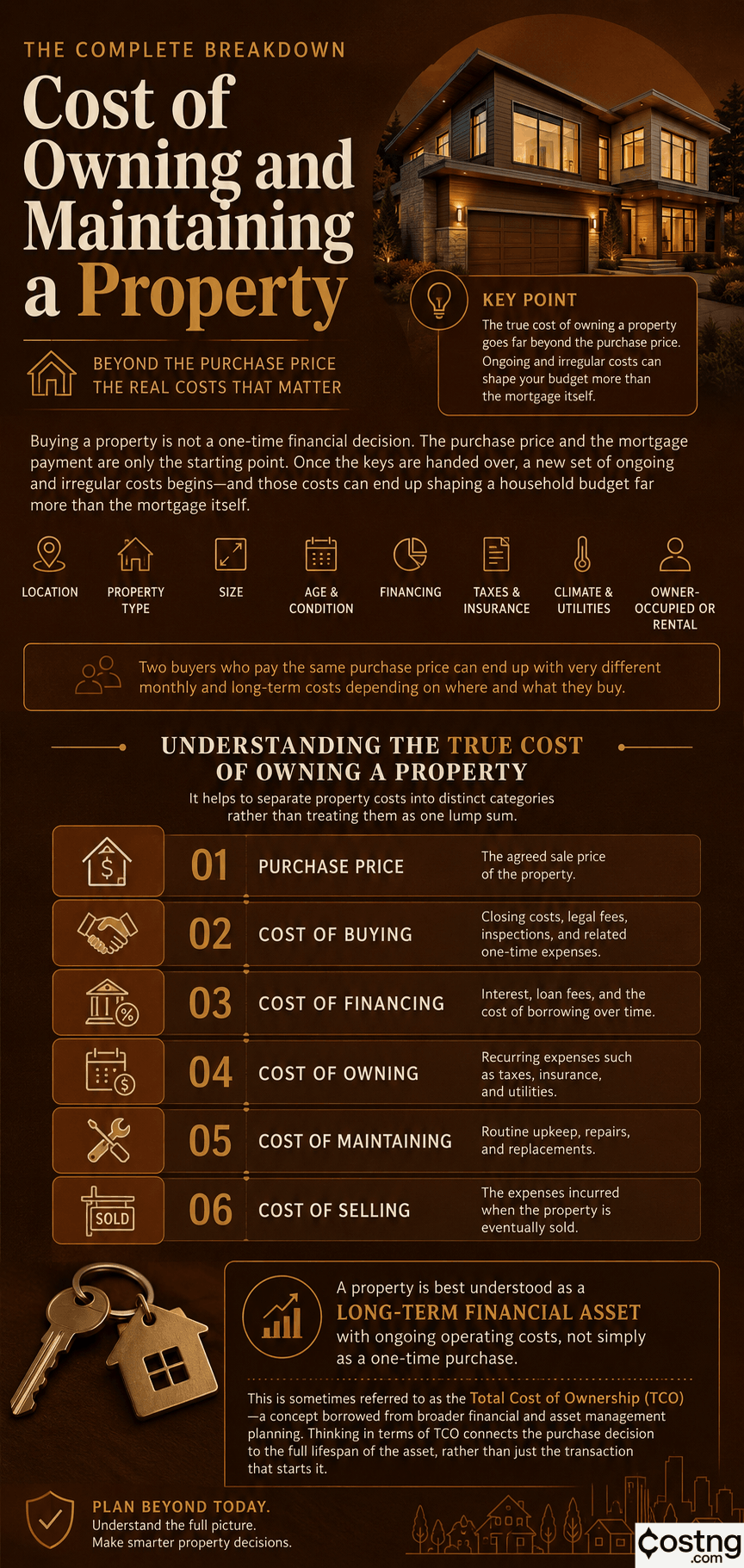
Buying a property is not a one-time financial decision. The purchase price and the mortgage payment are only the starting point. Once the keys are handed over, a new set of ongoing and irregular costs begins — and those costs can end up shaping a household budget far more than the mortgage itself.
The true cost of owning a property depends on a combination of factors: location, property type, size, age and condition, how the purchase was financed, local taxes, insurance requirements, climate, utility prices, maintenance needs, and whether the property is owner-occupied or rented out. Two buyers who pay the same purchase price can end up with very different monthly and long-term costs depending on where and what they buy.
This guide breaks down every layer of property ownership cost — from the one-time costs of buying, to the recurring costs of owning, to the often-underestimated costs of maintaining a property over time.
What Is the True Cost of Owning a Property?
It helps to separate property costs into distinct categories rather than treating them as one lump sum:
- Purchase price: The agreed sale price of the property
- Cost of buying: Closing costs, legal fees, inspections, and related one-time expenses
- Cost of financing: Interest, loan fees, and the cost of borrowing over time
- Cost of owning: Recurring expenses such as taxes, insurance, and utilities
- Cost of maintaining: Routine upkeep, repairs, and replacements
- Cost of selling: The expenses incurred when the property is eventually sold
A property is best understood as a long-term financial asset with ongoing operating costs, not simply as a one-time purchase. This is sometimes referred to as the Total Cost of Ownership (TCO), a concept borrowed from broader financial and asset management planning. Thinking in terms of TCO connects the purchase decision to the full lifespan of the asset, rather than just the transaction that starts it.
One-Time Costs of Buying a Property
These are the costs that occur before or around the purchase itself, separate from the ongoing costs of living in and maintaining the property.
Down Payment
The down payment is the portion of the purchase price paid upfront, with the remainder financed through a mortgage or loan. A larger down payment typically reduces the amount borrowed, which can lower monthly financing costs and, in some markets, help avoid additional lender-required insurance. That said, buyers should be cautious about putting every available dollar into the down payment. Closing costs, moving expenses, and an emergency reserve for early repairs all need to be funded separately, and a buyer with no cash reserves left after closing is more exposed to financial stress if something goes wrong soon after moving in.
Closing Costs
Closing costs cover the administrative and legal work required to complete a property transaction. Depending on the country and jurisdiction, these may include:
- Legal fees
- Title fees
- Registration fees
- Transfer taxes
- Stamp duty
- Loan origination fees
- Valuation fees
Closing costs vary significantly by country, region, and even municipality, so there is no single global percentage that applies everywhere. Buyers should check the specific fee structure that applies in their local market rather than relying on a general rule of thumb.
Property Inspection and Valuation
A professional inspection before purchase can reveal problems that aren't visible during a casual walkthrough, including:
- Structural problems
- Roofing issues
- Plumbing issues
- Electrical problems
- Moisture or mold
- HVAC problems
Identifying these issues before closing gives a buyer the opportunity to negotiate on price, request repairs, or walk away — all of which are far cheaper than discovering the same problems after moving in.
Moving and Initial Setup Costs
Beyond the purchase itself, most buyers face a round of setup costs when they take possession of a property:
- Moving services
- Furniture
- Appliances
- Painting
- Security systems
- Initial repairs
- Utility connection fees
These costs are easy to underestimate because they don't appear on a mortgage statement, but they can add up to a meaningful sum in the first few months of ownership.
Ongoing Costs of Owning a Property
This is the core of what it actually costs to own a property year after year.
Mortgage or Financing Costs
A mortgage payment is generally made up of:
- Principal: The portion that reduces the amount owed
- Interest: The cost of borrowing, based on the loan term and interest rate
- Loan term: The length of time over which the loan is repaid
- Interest rate: Fixed or variable, and a major driver of total financing cost
- Refinancing: The option to replace an existing loan with a new one, potentially at a different rate
- Financing fees: Costs associated with arranging or maintaining the loan
Property Taxes
Property taxes are typically based on:
- Assessed property value
- Local tax rates
- Municipality
- Property type
- Local government rules
Because property taxes are set locally, they can vary substantially even between neighboring towns or districts. They should be treated as part of a broader cost-of-living calculation rather than a fixed, predictable line item.
Property Insurance
Depending on the property type and use, relevant insurance types can include:
- Homeowners insurance
- Building insurance
- Contents insurance
- Landlord insurance
- Flood insurance
- Disaster coverage
Insurance premiums are influenced by several factors:
- Property location
- Construction type
- Property age
- Replacement value
- Local risks (flood zones, wildfire areas, storm exposure)
- Coverage level
A property in a higher-risk area — such as a flood plain or a region prone to wildfires — will typically carry a higher insurance cost than a comparable property in a lower-risk location.
Utilities
Utility costs are one of the most consistent monthly expenses of property ownership and include:
- Electricity
- Gas
- Water
- Waste collection
- Internet
- Heating
- Cooling
These costs are shaped by:
- Property size
- Number of occupants
- Climate
- Energy efficiency
- Local prices
- Appliances in use
Utility costs can vary widely between two similar-sized properties depending on insulation quality, appliance efficiency, and local climate — a poorly insulated home in a cold climate can cost significantly more to heat than a well-insulated one of the same size.
HOA, Body Corporate, or Service Charges
Depending on the market, this fee goes by different names:
- Homeowners association (HOA) fees
- Strata fees
- Body corporate fees
- Service charges
- Community fees
- Property management fees
These charges typically fund shared costs such as:
- Shared-area maintenance
- Security
- Landscaping
- Building insurance
- Elevators
- Swimming pools
- Common facilities
They can be billed monthly, quarterly, or annually, and may also include special assessments — one-off charges levied when a shared building or community needs unplanned or major work, such as a roof replacement or structural repair.
Property Maintenance Costs
Maintenance is where many buyers underestimate the true cost of ownership, because it's less predictable than a mortgage payment or a fixed tax bill.
Routine Maintenance
Routine maintenance includes recurring tasks that keep a property in good condition:
- HVAC servicing
- Plumbing checks
- Electrical inspections
- Pest control
- Gutter cleaning
- Landscaping
- Painting
- Cleaning
- Appliance servicing
Routine maintenance is generally more predictable than major repairs, but neglecting it tends to increase costs later — a small plumbing leak left unaddressed, for example, can turn into water damage that costs far more to fix.
Major Repairs and Replacements
Larger components of a property have their own lifecycle of repair and replacement:
| Component | Common Cost Type | Frequency |
|---|---|---|
| Roof | Major replacement | Long-term |
| HVAC system | Repair/replacement | Periodic |
| Water heater | Replacement | Periodic |
| Plumbing | Repair | Irregular |
| Electrical system | Repair/upgrade | Irregular |
| Appliances | Replacement | Periodic |
| Exterior | Painting/repair | Periodic |
It's worth being precise about the terminology here, since these are not interchangeable concepts:
- Maintenance prevents deterioration (e.g., servicing an HVAC system annually)
- Repair fixes an existing problem (e.g., patching a leaking pipe)
- Replacement replaces an asset that has reached the end of its useful life (e.g., installing a new roof)
Understanding which category a cost falls into helps with budgeting, since each behaves differently — maintenance is scheduled and predictable, repairs are irregular, and replacements are infrequent but expensive.
How Much Should You Budget for Property Maintenance?
There is no single rule that applies to every property. The right maintenance reserve depends on:
- Property age
- Property size
- Property condition
- Climate
- Construction quality
- Location
- Existing systems (HVAC, plumbing, electrical)
- Availability and cost of local contractors
Some financial guides use a percentage of property value as a rough starting point — commonly citing a range of around 1%–3% annually — while other commentary argues that older or higher-risk properties may need to budget for more. These percentage rules are best treated as starting estimates, not universal laws, since they don't account for a property's specific age, condition, or location.
A useful formula for building a maintenance reserve:
Annual Maintenance Reserve = Routine Maintenance + Expected Repairs + Long-Term Replacement Reserve
This approach is more financially accurate than a flat percentage because it reflects the actual condition and systems of the specific property, rather than assuming every property ages and deteriorates at the same rate.
Hidden Costs of Owning a Property
Some of the most significant property costs aren't monthly line items — they're irregular expenses that show up unexpectedly. This category includes:
- Unexpected repairs
- Emergency maintenance
- Special assessments
- Rising insurance premiums
- Property tax increases
- Renovation costs
- Pest treatment
- Compliance costs (permits, code upgrades)
- Security costs
- Seasonal maintenance
- Vacancy costs for rental properties
How Location Affects the Cost of Owning a Property
Two nearly identical properties can have very different total ownership costs simply because of where they're located. Location influences:
- Property taxes
- Insurance premiums
- Utility prices
- Labour costs
- Contractor prices
- Climate
- Flood or fire risk
- Local regulations
- Service charges
- Transportation costs
A property in a region with high flood risk, for instance, may carry substantially higher insurance premiums than a similar property in a lower-risk area, while a property in a region with expensive skilled labor will typically cost more to maintain and repair. Location-based cost differences are often larger than buyers expect, which is why comparing the total ownership cost — not just the purchase price — across different areas matters.
How Property Type Affects Ownership Costs
Different property types carry different cost structures.
Detached House
A detached house typically involves full responsibility for:
- Roof
- Exterior
- Yard
- Driveway
- HVAC
- Plumbing
- Structural maintenance
Because there's no shared building or association, the owner bears the full cost of every repair and replacement directly.
Apartment or Condominium
Ownership costs for an apartment or condo are often split between individual and shared responsibilities:
- HOA or body corporate fees
- Shared building maintenance
- Elevator costs
- Building insurance
- Special assessments
While individual owners may face lower direct repair costs, they are exposed to shared costs decided by the building or association, including special assessments they may not control.
Rental or Investment Property
A property held as a rental carries additional costs beyond standard ownership:
- Property management
- Vacancy periods with no rental income
- Tenant turnover costs
- Landlord insurance
- Legal compliance
- Tenant-related repairs
These costs mean that a rental property's break-even point is usually higher than the mortgage and tax bill alone would suggest.
Older Property
Older properties tend to carry a higher risk of elevated costs in several areas:
- Repair costs
- Energy costs (often due to lower efficiency)
- Plumbing problems
- Electrical upgrades
- Structural repairs
This doesn't mean every older property is expensive to maintain, but age increases the likelihood that major systems are approaching the end of their useful life.
How to Calculate the Monthly Cost of Owning a Property
A more complete monthly cost formula looks like this:
Monthly Property Ownership Cost = Mortgage Payment + (Property Taxes ÷ 12) + (Insurance ÷ 12) + Utilities + Maintenance Reserve + Repair Reserve + HOA/Service Charges + Other Recurring Costs
From there, it helps to think in three timeframes:
- Monthly Cash Flow Cost: what must actually be paid or set aside each month
- Annual Ownership Cost: the total cost over 12 months
- Long-Term Ownership Cost: the cost projected over 5, 10, or 20 years, including major replacements and repairs
Looking at all three timeframes together gives a far more realistic picture than focusing on the mortgage payment alone.
Example: Calculating the Total Cost of Property Ownership
The following is a fictional, illustrative example and is not a universal average.
Property details:
- Purchase price: $300,000
- Mortgage payment: $1,800 /month
- Property taxes: $3,600 /year
- Insurance: $1,500 /year
- Utilities: $300 /month
- Maintenance reserve: $350 /month
- Repair reserve: $200 /month
- HOA: $150 /month
Monthly cost breakdown:
| Category | Monthly Cost |
|---|---|
| Mortgage | $1,800 |
| Property Tax | $300 |
| Insurance | $125 |
| Utilities | $300 |
| Maintenance Reserve | $350 |
| Repair Reserve | $200 |
| HOA | $150 |
| Total | $3,225/month |
Maintenance Reserve vs. Repair Reserve
Although they are sometimes combined into one category, maintenance and repairs serve different purposes:
- Maintenance Reserve: Money set aside for predictable or routine upkeep, such as HVAC servicing, landscaping, gutter cleaning, pest control, or routine appliance maintenance.
- Repair Reserve: Money set aside for unexpected or less predictable problems, such as a leaking roof, broken water heater, plumbing failure, damaged appliances, or electrical repairs.
Keeping separate reserves can make a property ownership budget more realistic and reduce the risk of treating an unexpected repair as an unplanned financial emergency.
Property Ownership Costs vs Renting
This isn't a full "buy vs. rent" debate; it's simply a comparison of cost categories between the two.
| Cost Category | Owning | Renting |
|---|---|---|
| Housing payment | Mortgage | Rent |
| Property taxes | Paid directly | Usually included indirectly |
| Insurance | Homeowners/building insurance | Renter's insurance |
| Maintenance | Usually owner responsibility | Usually landlord responsibility |
| Repairs | Usually owner responsibility | Usually landlord responsibility |
| HOA/service fees | Often paid directly | Usually not directly paid |
| Equity building | Builds ownership equity | No direct ownership equity |
| Flexibility | Typically lower | Typically greater |
The cheaper option depends on the specific market, time horizon, financing terms, property price, maintenance requirements, and the opportunity cost of the capital tied up in a down payment. There's no universal answer that applies across every market and situation.
How to Create a Property Ownership Budget
A structured approach can make property costs far easier to plan for.
Step 1: Calculate Upfront Costs
Down payment, Closing costs, Inspection, Moving, Initial repairs.
Step 2: Calculate Fixed Monthly Costs
Mortgage, Taxes, Insurance, HOA/service charges.
Step 3: Estimate Variable Costs
Utilities, Maintenance, Repairs, Landscaping.
Step 4: Build Maintenance and Repair Reserves
Set aside separate amounts for:
- Maintenance Reserve: Routine property upkeep, HVAC servicing, Landscaping, Pest control, Gutter and exterior maintenance.
- Repair Reserve: Unexpected plumbing or electrical repairs, Roof repairs, HVAC or water-heater failures, Appliance replacements, Other unforeseen property repairs.
A repair reserve is particularly important because some property expenses cannot be predicted accurately on a month-to-month basis.
Step 5: Build an Emergency Reserve
Keep a separate emergency fund for:
- Major unexpected repairs
- Emergency replacements
- Temporary income disruption
- Other unexpected financial needs
The emergency reserve should not necessarily be treated as a normal monthly ownership expense. Instead, it acts as an additional financial safety net beyond the regular maintenance and repair reserves.
Step 6: Review Long-Term Costs
Periodically reassess:
- Major replacements coming due
- Renovations
- Roof, HVAC, plumbing, and electrical systems
- Selling costs
- Financing changes, such as refinancing opportunities
- Changes in property taxes, insurance, HOA fees, and utilities
Frequently Asked Questions
How much does it cost to own a property each month?
It depends on the mortgage, taxes, insurance, utilities, maintenance, service charges, and location. There is no single figure that applies to every property.
What is the biggest ongoing cost of owning a property?
This varies by property and location. Financing, taxes, utilities, insurance, and maintenance can each be significant depending on the specific property and market.
How much should I budget for property maintenance?
There is no universal amount. Use the property's age, size, condition, systems, location, and expected repair costs to build a maintenance reserve suited to that specific property.
Is property maintenance included in the mortgage?
Usually, no. Maintenance and repairs are generally separate expenses that the owner budgets for independently of the mortgage payment.
What are the hidden costs of owning a property?
Common examples include unexpected repairs, property tax increases, rising insurance premiums, HOA special assessments, utility cost changes, major replacements, and legal or compliance costs.
Is owning a property more expensive than renting?
There is no universal answer. Compare total ownership costs not just the mortgage payment against rent and other housing expenses to make an accurate comparison for a specific situation.