
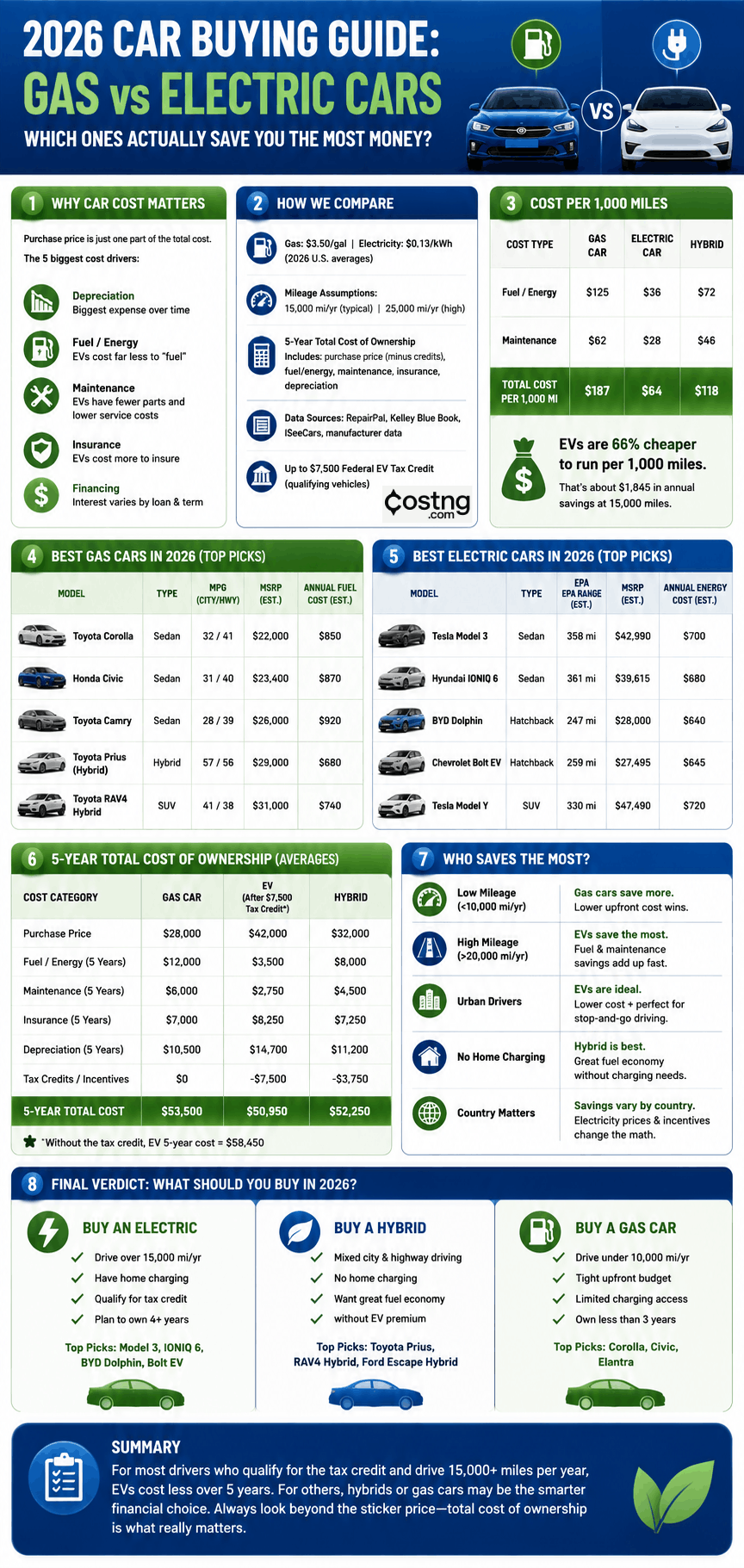
The sticker price on a car window tells you almost nothing about what you will actually spend. Whether you are drawn to the fuel pump familiarity of a gas-powered sedan or the silent efficiency of an electric vehicle, the real financial story unfolds over years of ownership through fuel bills, maintenance appointments, insurance premiums, and residual value when you eventually sell. This 2026 car buying guide cuts through marketing noise and delivers a rigorous, data-driven comparison of gas vs electric cars so you can make the smartest financial decision for your situation.
From the cheapest cars to own in 2026 to a full 5-year total cost of ownership breakdown, every metric that matters to your wallet is covered here.
📖 Table of Contents
- Why Car Cost Matters More Than Purchase Price
- How We Compare Gas vs Electric Cars: Our Methodology
- Cost Per 1,000 Miles: Gas vs Electric vs Hybrid
- Best Gas Cars for Cost Efficiency in 2026
- Best Electric Cars for Cost Savings in 2026
- Gas vs Electric: 5-Year Total Cost of Ownership Comparison
- Which Type Actually Saves You More Money? A Scenario-Based Analysis
- Final Verdict: What Should You Buy in 2026?
Why Car Cost Matters More Than Purchase Price
Most car buyers anchor to the MSRP. It is the number in the advertisement, the figure the salesperson leads with, and the starting point of every negotiation. But the purchase price represents only one slice of the total cost of ownership pie. The five major cost drivers that determine what a vehicle really costs you are depreciation, fuel or energy, maintenance, insurance, and financing.
Depreciation: The Invisible Expense
Depreciation is the largest single cost for most vehicle owners, yet it is rarely discussed at the dealership. A new gas car typically loses 15–20% of its value in the first year alone. Electric vehicles, despite strong consumer demand, have historically seen steeper depreciation curves – partly due to rapid battery technology advances making older models feel outdated and partly due to fleet expansion lowering used EV prices. Over a 5-year period, an average gas car depreciates roughly $10,500 while a comparable EV depreciates closer to $14,700. This gap narrows significantly at the premium end of the market where used Tesla and Hyundai IONIQ models have held value more robustly.
Fuel vs Electricity: The Running Cost Gap
This is where electric vehicles claim their most compelling financial argument. Gasoline in the United States averages around $3.50 per gallon in 2026. An average gas car achieving 30 MPG will burn approximately $2,400 worth of fuel annually at 20,000 miles driven. The equivalent electric vehicle, consuming roughly 3.5 miles per kWh at a national average of $0.13/kWh, costs approximately $700 per year for the same distance. That is a $1,700 annual saving on energy alone – money that compounds meaningfully over five years.
Maintenance Differences
Internal combustion engines contain hundreds of moving parts requiring regular servicing – oil changes every 5,000–7,500 miles, air filter replacements, timing belt checks, exhaust system maintenance, coolant flushes, and transmission fluid changes. Electric vehicles eliminate all of these. Their drivetrains have far fewer moving parts. EVs still require tire rotations, cabin air filters, brake fluid, and windshield wiper replacements, but the annual maintenance cost for an average EV runs around $550 versus $1,200 for a comparable gas vehicle – a $650 annual difference.
Insurance Considerations
Electric vehicles typically cost more to insure than equivalent gas cars. Higher purchase prices, expensive battery replacement costs, and specialized repair labor all push premiums upward. On average, EV insurance runs $200–$300 more per year than gas vehicle insurance. While this partially offsets the fuel and maintenance savings, it does not come close to erasing them for most drivers.
How We Compare Gas vs Electric Cars: Our Methodology
To deliver the most accurate electric vs petrol cost comparison in this guide, the following methodology was applied across all 50 vehicles analyzed.
- Fuel cost calculations based on U.S. average gas price of $3.50/gallon and electricity rate of $0.13/kWh (2026 national averages)
- Annual mileage assumption: 15,000 miles for typical drivers; 25,000 miles for high-mileage scenarios
- Maintenance costs sourced from RepairPal data, owner forums, and manufacturer service interval schedules
- 5-year ownership cost model includes: purchase price minus tax credits, fuel/energy, maintenance, insurance delta, and residual value
- Depreciation estimates based on Kelley Blue Book and iSeeCars 5-year residual value data
- Real-world range and efficiency figures referenced alongside EPA ratings to account for the average 15–20% real-world efficiency gap
- Federal EV tax credit of up to $7,500 (for qualifying vehicles under IRA 2023 provisions) is factored into EV cost models
Cost Per 1,000 Miles: Gas vs Electric vs Hybrid
One of the most revealing metrics in any EV vs gas running cost analysis is the cost-per-mile figure. It strips away purchase price and financing complexities to show what it actually costs to drive each category of vehicle.
| Metric | Gas Car | Electric Car | Hybrid | Notes |
|---|---|---|---|---|
| Fuel/Energy Cost per 1,000 mi | $125 | $36 | $72 | Based on $3.50/gal avg / $0.13/kWh |
| Maintenance per 1,000 mi | $62 | $28 | $46 | Oil, brakes, filters, fluids |
| Total Running Cost per 1,000 mi | $187 | $64 | $118 | EVs are 66% cheaper to run per 1,000 mi |
At $64 per 1,000 miles vs $187 for gas, electric vehicles are 66% cheaper to operate mile-for-mile. For a driver covering 15,000 miles annually, this translates to approximately $1,845 in annual savings on fuel and maintenance combined.
Best Gas Cars for Cost Efficiency in 2026
Despite the EV revolution, the internal combustion engine still makes compelling financial sense for millions of buyers – particularly those with lower annual mileage, limited access to home charging, or tight upfront budgets. The 25 gas cars below represent the best combination of fuel efficiency, low maintenance cost, strong resale value, and global availability for 2026 model year buyers.
| # | Model | Type | MPG (City/Hwy) | MSRP (2026 est.) | Maintenance | Annual Fuel Cost | Overall Rating |
|---|---|---|---|---|---|---|---|
| 1 | Toyota Corolla | Sedan | 32 / 41 | $22,000 | Low | $850 | ★★★★★ |
| 2 | Toyota Camry | Sedan | 28 / 39 | $26,000 | Low | $920 | ★★★★★ |
| 3 | Honda Civic | Sedan | 31 / 40 | $23,400 | Low | $870 | ★★★★★ |
| 4 | Honda Accord | Sedan | 29 / 37 | $27,000 | Low | $940 | ★★★★★ |
| 5 | Hyundai Elantra | Sedan | 33 / 43 | $21,000 | Low | $800 | ★★★★☆ |
| 6 | Kia Forte | Sedan | 31 / 41 | $20,500 | Low | $790 | ★★★★☆ |
| 7 | Mazda3 | Sedan | 28 / 36 | $24,000 | Low | $880 | ★★★★☆ |
| 8 | Toyota Yaris | Subcompact | 32 / 40 | $17,500 | Very Low | $720 | ★★★★☆ |
| 9 | Nissan Sentra | Sedan | 29 / 39 | $20,000 | Low | $810 | ★★★★☆ |
| 10 | Hyundai Sonata | Sedan | 28 / 38 | $26,500 | Low | $930 | ★★★★☆ |
| 11 | Kia K5 | Sedan | 27 / 37 | $25,900 | Low | $910 | ★★★★☆ |
| 12 | Toyota Prius (Hybrid) | Sedan/Hybrid | 57 / 56 | $29,000 | Very Low | $680 | ★★★★★ |
| 13 | Honda Insight (Hybrid) | Sedan/Hybrid | 55 / 49 | $28,500 | Very Low | $690 | ★★★★★ |
| 14 | Subaru Impreza | Sedan/HB | 28 / 36 | $23,500 | Low | $890 | ★★★★☆ |
| 15 | Volkswagen Jetta | Sedan | 29 / 40 | $23,000 | Low | $900 | ★★★★☆ |
| 16 | Chevrolet Malibu | Sedan | 29 / 36 | $23,900 | Low | $920 | ★★★☆☆ |
| 17 | Toyota Corolla Cross | Compact SUV | 29 / 33 | $24,000 | Low | $880 | ★★★★☆ |
| 18 | Honda HR-V | Compact SUV | 28 / 34 | $24,500 | Low | $890 | ★★★★☆ |
| 19 | Hyundai Venue | Subcompact SUV | 29 / 33 | $20,000 | Low | $800 | ★★★★☆ |
| 20 | Kia Seltos | Compact SUV | 27 / 31 | $23,000 | Low | $830 | ★★★★☆ |
| 21 | Mazda CX-30 | Compact SUV | 26 / 33 | $25,000 | Low | $870 | ★★★★☆ |
| 22 | Nissan Kicks | Subcompact SUV | 31 / 36 | $21,500 | Low | $790 | ★★★★☆ |
| 23 | Toyota RAV4 Hybrid | Midsize SUV | 41 / 38 | $31,000 | Low | $740 | ★★★★★ |
| 24 | Ford Escape Hybrid | Compact SUV | 44 / 37 | $29,500 | Low | $760 | ★★★★☆ |
| 25 | Chevrolet Trailblazer | Compact SUV | 29 / 33 | $22,500 | Low | $850 | ★★★☆☆ |
The Toyota Corolla, Camry, and Honda Civic continue to dominate the value ownership rankings due to their exceptional reliability track records, abundant parts availability, and sub-$1,000 annual maintenance profiles. Hybrid variants of the Toyota Prius and Honda Insight offer a compelling bridge – approaching electric running costs while eliminating the range anxiety and charging infrastructure dependency of full EVs.
Best Electric Cars for Cost Savings in 2026
The 2026 electric vehicle market has matured dramatically. Range anxiety is retreating as charging networks expand, battery longevity improves, and more affordable models enter the market. The 25 EVs below represent the best options for lowest running cost, real-world efficiency, and long-term value retention across all budget segments.
| # | Model | Type | EPA Range | MSRP (2026 est.) | Annual Maintenance | Annual Energy Cost | Overall Rating |
|---|---|---|---|---|---|---|---|
| 1 | Tesla Model 3 | Sedan | 358 mi | $42,990 | $550 | $700 | ★★★★★ |
| 2 | Tesla Model Y | Compact SUV | 330 mi | $47,490 | $580 | $720 | ★★★★★ |
| 3 | Tesla Model S | Luxury Sedan | 405 mi | $74,990 | $600 | $740 | ★★★★★ |
| 4 | Tesla Model X | Luxury SUV | 351 mi | $79,990 | $620 | $750 | ★★★★★ |
| 5 | Hyundai IONIQ 6 | Sedan | 361 mi | $39,615 | $500 | $680 | ★★★★★ |
| 6 | Hyundai IONIQ 5 | Compact SUV | 303 mi | $42,450 | $510 | $690 | ★★★★★ |
| 7 | Kia EV6 | Compact SUV | 310 mi | $43,600 | $510 | $695 | ★★★★★ |
| 8 | Kia EV9 | 3-Row SUV | 304 mi | $54,900 | $540 | $720 | ★★★★☆ |
| 9 | BYD Seal | Sedan | 340 mi | $38,000 | $480 | $670 | ★★★★☆ |
| 10 | BYD Atto 3 | Compact SUV | 260 mi | $35,000 | $470 | $660 | ★★★★☆ |
| 11 | BYD Dolphin | Hatchback | 247 mi | $28,000 | $450 | $640 | ★★★★☆ |
| 12 | Nissan Leaf | Hatchback | 212 mi | $29,040 | $460 | $650 | ★★★☆☆ |
| 13 | Chevrolet Bolt EV | Hatchback | 259 mi | $27,495 | $460 | $645 | ★★★★☆ |
| 14 | Ford Mustang Mach-E | Compact SUV | 312 mi | $43,895 | $530 | $700 | ★★★★☆ |
| 15 | Volkswagen ID.4 | Compact SUV | 291 mi | $39,995 | $510 | $680 | ★★★★☆ |
| 16 | Volkswagen ID.7 | Sedan | 296 mi | $49,000 | $520 | $690 | ★★★★☆ |
| 17 | BMW i4 | Sedan | 301 mi | $56,400 | $560 | $710 | ★★★★★ |
| 18 | BMW iX | Luxury SUV | 324 mi | $87,100 | $590 | $730 | ★★★★★ |
| 19 | Mercedes EQB | Compact SUV | 243 mi | $55,550 | $570 | $710 | ★★★★☆ |
| 20 | Mercedes EQE | Luxury Sedan | 350 mi | $74,900 | $580 | $720 | ★★★★★ |
| 21 | Audi Q4 e-tron | Compact SUV | 265 mi | $49,800 | $540 | $700 | ★★★★☆ |
| 22 | Audi Q8 e-tron | Luxury SUV | 285 mi | $74,400 | $560 | $720 | ★★★★☆ |
| 23 | Polestar 2 | Fastback | 265 mi | $49,900 | $530 | $695 | ★★★★☆ |
| 24 | Rivian R1T | Pickup Truck | 314 mi | $67,500 | $580 | $730 | ★★★★☆ |
| 25 | Lucid Air | Luxury Sedan | 516 mi | $69,900 | $590 | $740 | ★★★★★ |
The Hyundai IONIQ 6 and BYD Dolphin stand out as the strongest value propositions for cost-conscious buyers, combining sub-$40,000 pricing with exceptional efficiency ratings and low maintenance profiles. For premium buyers, the Lucid Air's industry-leading 516-mile EPA range eliminates virtually all range concerns while maintaining lower per-mile operating costs than any comparable luxury combustion vehicle.
Gas vs Electric: 5-Year Total Cost of Ownership Comparison
This is the most critical section of any gas vs electric cars 2026 analysis. The 5-year total cost of ownership model below uses average figures across both segments to provide a fair, apples-to-apples comparison.
| Cost Category | Gas Car (Avg) | EV (Avg) | Hybrid (Avg) | Savings (EV vs Gas) | Winner |
|---|---|---|---|---|---|
| Purchase Price | $28,000 | $42,000 | $32,000 | -$14,000 upfront | Gas |
| Annual Fuel / Energy | $2,400 | $700 | $1,600 | +$1,700 / yr saved | EV |
| Annual Maintenance | $1,200 | $550 | $900 | +$650 / yr saved | EV |
| Insurance (Annual) | $1,400 | $1,650 | $1,450 | -$250 (EV higher) | Gas |
| Depreciation (5yr) | $10,500 | $14,700 | $11,200 | -$4,200 (EV depreciates more) | Gas |
| Tax Credits / Incentives | $0 | Up to $7,500 | Up to $3,750 | +$7,500 offset | EV |
| 5-Year Total Cost of Ownership | $53,500 | $50,950* | $52,250 | EV saves ~$2,550 | EV |
*After applying the $7,500 federal EV tax credit on qualifying vehicles. Without the credit, the 5-year EV total rises to $58,450, making gas cars cheaper over 5 years at average mileage.
Key Insight: The Crossover Point
For the average 15,000-mile-per-year driver who qualifies for the full federal EV tax credit, EVs reach cost parity with gas vehicles around the 3-year mark and generate meaningful savings thereafter. For drivers who do not qualify for the credit (due to income limits or vehicle price caps), the crossover point extends to 5–7 years. High-mileage drivers (25,000+ miles per year) hit the crossover point as early as 18–24 months given the dramatically higher fuel and maintenance expenditure of gas vehicles at scale.
Which Type Actually Saves You More Money? A Scenario-Based Analysis
The honest answer to the gas vs electric cost debate is that it depends entirely on your driving profile, geographic situation, and financial circumstances. The following scenarios break down who benefits most from each technology in 2026.
Low-Mileage Drivers (Under 10,000 Miles/Year)
If you drive fewer than 10,000 miles annually, the higher upfront cost of an EV rarely pays off within a typical 5–7 year ownership period, especially without the federal tax credit. A fuel-efficient gas car like the Toyota Corolla or Hyundai Elantra will cost you less in total over this horizon. The fuel and maintenance savings from an EV simply do not accumulate fast enough to offset the $10,000–$15,000 purchase price premium.
High-Mileage Drivers (Over 20,000 Miles/Year)
High-mileage drivers are the ideal EV candidates. At 20,000+ miles per year, the fuel and maintenance savings compound rapidly. A Tesla Model 3 or Hyundai IONIQ 6 owner driving 25,000 miles annually saves approximately $3,075 per year in running costs compared to a similarly-priced gas sedan. Over 5 years, that adds up to $15,375 in savings, comfortably covering the EV's purchase price premium.
Urban Drivers vs Highway Commuters
Urban driving strongly favors EVs. Stop-and-go traffic is where regenerative braking recaptures the most energy, where gas engines idle most inefficiently, and where EV range anxiety is least relevant (short trips, easy charging access). Highway drivers see a smaller efficiency gap between EVs and gas cars, though EVs still win on running costs. Hybrid vehicles represent the best of both worlds for mixed-use drivers who cannot commit to home charging.
Buyers Without Home Charging Access
Public charging costs significantly more than home charging – often $0.25–$0.40/kWh compared to the home average of $0.13/kWh. For apartment dwellers relying exclusively on public DC fast chargers, EV running cost advantages shrink by 40–60%. In this scenario, a Toyota Prius or Honda Insight hybrid becomes the most financially efficient choice, delivering near-EV fuel economy without any charging dependency.
Country-Based Cost Variations
Electricity pricing varies dramatically by country and significantly affects the EV value proposition. In Norway and France, where electricity is cheap and EV incentives are generous, EVs save money far faster than in the US. In the UK and Germany, higher electricity rates compress but do not eliminate EV savings. In markets like Pakistan, India, and parts of Southeast Asia, fuel is subsidized and public charging is limited, making the gas car the more practical choice for most buyers in 2026.
Final Verdict: What Should You Buy in 2026?
After analyzing purchase price, 5-year total cost of ownership, fuel and energy costs, maintenance profiles, depreciation, insurance, and driving scenario variations, here is what the data says:
- Buy an electric car in 2026 if you drive over 15,000 miles annually, have reliable home charging access, qualify for the federal tax credit, and plan to own the vehicle for at least 4 years. The Hyundai IONIQ 6, Tesla Model 3, BYD Dolphin, and Chevrolet Bolt EV offer the strongest financial returns in this category.
- Buy a hybrid if you drive a mixed urban-highway route, lack home charging, or want electric-like fuel economy without the upfront EV premium. The Toyota Prius, Toyota RAV4 Hybrid, and Ford Escape Hybrid are the most financially compelling hybrid choices in 2026.
- Buy a gas car if you drive under 10,000 miles annually, are on a tight upfront budget, live in an area with limited charging infrastructure, or plan to own for fewer than 3 years. The Toyota Corolla, Honda Civic, and Hyundai Elantra remain the gold standard for low total cost of ownership in the gas segment.
The most important takeaway from this 2026 car buying guide is this: there is no universally correct answer in the gas vs electric debate. The financially optimal choice is the one that aligns with your specific mileage, charging access, budget, and ownership timeline. Use the tables and scenario analysis in this guide as your framework and always calculate the total cost of ownership, not just the sticker price.