
A place that feels affordable today might become expensive over time, while another state could offer better tax advantages, stronger healthcare systems, and a lifestyle that aligns perfectly with your goals.
That’s why finding the best state for retirees requires more than just looking at warm weather or low housing costs. You need to evaluate how retirement income is taxed, whether your Social Security benefits are protected, the availability of high-quality healthcare, and how safe and enjoyable the environment is for everyday living. Factors like climate, proximity to family, senior-friendly communities, and recreational opportunities also play a major role in shaping your retirement experience.
In this guide, we’ll break down the best states for retirees in 2026 based on key criteria like affordability, tax friendliness, healthcare quality, and lifestyle benefits. You’ll discover top-ranked states such as Florida, Arizona, Texas, and North Carolina along with insights into what makes each one ideal (or not) for retirement. Whether you’re planning to retire on a fixed budget or looking for a high-quality lifestyle with excellent amenities, this guide will help you make a confident, informed decision.
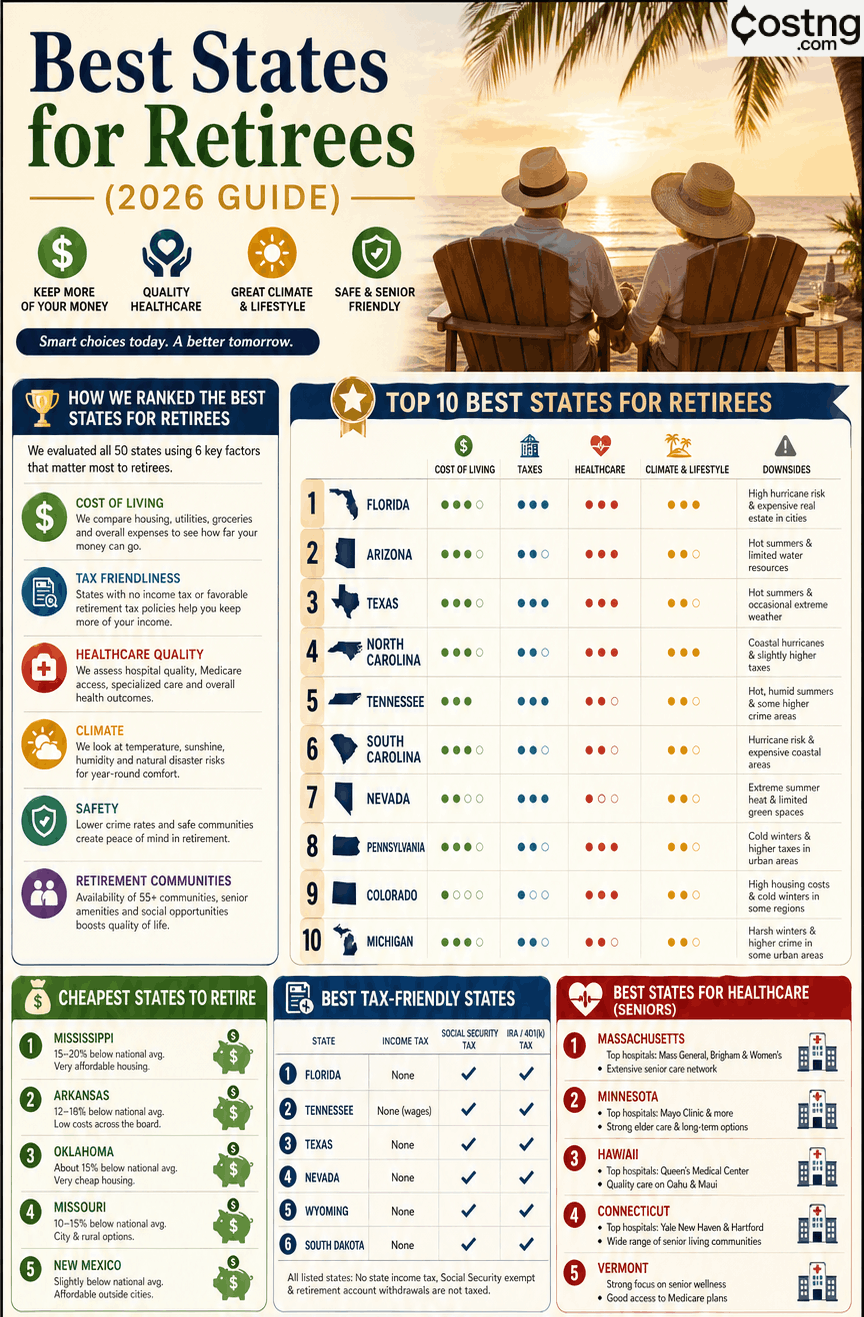
How We Ranked the Best States for Retirees
Choosing the best state to retire isn’t about a single factor, it's about how multiple elements come together to support your financial stability, health, and overall lifestyle. To create a meaningful and practical ranking, we evaluated each state based on the factors that matter most to retirees in real-world decision-making.
- Cost of Living – Affordability for fixed incomes: housing, utilities, groceries.
- Tax Friendliness – State income tax, Social Security benefits, pension & 401(k)/IRA treatment.
- Healthcare Quality – Hospital quality, specialized care, Medicare accessibility.
- Climate – Mild winters, sunshine, natural disaster risks, humidity.
- Safety – Crime rates (violent & property), community safety.
- Retirement Community Availability – 55+ communities, assisted living, social engagement.
Top 10 Best States for Retirees
Here’s a detailed breakdown of the top states for retirement in 2026, based on cost, taxes, healthcare, climate, safety, and lifestyle. Each state includes key pros and cons to help you make an informed decision.
#1 Florida 🏆 Top pick
✅ Why it’s great: Florida is a retiree favorite for its sunny weather, no state income tax, and vibrant retirement communities.
💰 Cost of living: Slightly above the national average in urban areas; affordable options exist in smaller towns.
💸 Taxes: No state income tax; Social Security benefits are not taxed; property taxes are moderate.
🏥 Healthcare quality: Excellent healthcare system with top hospitals and specialized senior care facilities.
🌴 Lifestyle: Beaches, golf, cultural events, and strong retiree networks.
#2 Arizona
✅ Why it’s great: Arizona offers warm, dry weather and low cost of living, ideal for retirees seeking sunshine without humidity.
💰 Cost of living: Below the national average, especially outside Phoenix and Scottsdale.
💸 Taxes: No tax on Social Security; overall moderate tax burden.
🏥 Healthcare quality: Strong healthcare network with top-rated hospitals and senior services.
🌴 Lifestyle: Desert landscapes, hiking, golf, and growing retiree communities.
#3 Texas
✅ Why it’s great: Texas combines no state income tax with a wide variety of lifestyle options, from urban to rural living.
💰 Cost of living: Generally lower than the national average; affordable housing in many regions.
💸 Taxes: No state income tax; property taxes can be high in some areas.
🏥 Healthcare quality: Excellent hospitals and senior care facilities, especially in major cities.
🌴 Lifestyle: Urban culture in Austin, Houston, or Dallas; peaceful countryside options.
#4 North Carolina
✅ Why it’s great: North Carolina offers a moderate climate, beautiful landscapes, and growing retiree-friendly communities.
💰 Cost of living: Slightly below the national average; affordable housing outside major cities.
💸 Taxes: Social Security benefits partially taxed; overall moderate state taxes.
🏥 Healthcare quality: Highly rated hospitals and healthcare systems in urban centers.
🌴 Lifestyle: Mountains, beaches, golf, and cultural activities.
#5 Tennessee
✅ Why it’s great: Tennessee is tax-friendly, affordable, and has mild winters, making it appealing to retirees.
💰 Cost of living: Low; housing and daily expenses very reasonable.
💸 Taxes: No state income tax on wages; Social Security not taxed.
🏥 Healthcare quality: Quality healthcare facilities, particularly in Nashville and Memphis.
🌴 Lifestyle: Music, cultural events, and scenic countryside.
#6 South Carolina
✅ Why it’s great: South Carolina offers warm weather, scenic coasts, and affordable retirement options.
💰 Cost of living: Generally below the national average; coastal towns can be pricier.
💸 Taxes: Social Security benefits partially taxed; moderate overall tax burden.
🏥 Healthcare quality: Good access to hospitals and senior care facilities.
🌴 Lifestyle: Beaches, golf communities, and southern charm.
#7 Nevada
✅ Why it’s great: Nevada attracts retirees with no income tax, plenty of sunshine, and lively cities like Las Vegas and Reno.
💰 Cost of living: Moderate; urban areas can be expensive, but suburban and rural areas are affordable.
💸 Taxes: No state income tax; property taxes are reasonable.
🏥 Healthcare quality: High-quality hospitals in urban centers; fewer options in rural areas.
🌴 Lifestyle: Entertainment, outdoor recreation, and desert landscapes.
#8 Pennsylvania
✅ Why it’s great: Pennsylvania combines affordability, cultural richness, and access to excellent healthcare.
💰 Cost of living: Below national average in smaller towns; higher in Philadelphia and suburbs.
💸 Taxes: Social Security not taxed; income and property taxes moderate.
🏥 Healthcare quality: Highly rated hospitals and medical centers, especially in Pittsburgh and Philadelphia.
🌴 Lifestyle: Historical sites, outdoor recreation, and four-season climate.
#9 Colorado
✅ Why it’s great: Colorado is perfect for retirees who value outdoor activities, scenic landscapes, and a healthy lifestyle.
💰 Cost of living: Higher than the national average; mountain towns can be expensive.
💸 Taxes: Income tax applies; Social Security not taxed.
🏥 Healthcare quality: Excellent hospitals and wellness-focused facilities.
🌴 Lifestyle: Hiking, skiing, and active communities.
#10 Michigan
✅ Why it’s great: Michigan offers lakeside living, seasonal variety, and an affordable cost of living for retirees.
💰 Cost of living: Below national average, especially in smaller towns; housing very reasonable.
💸 Taxes: Social Security exempt from state taxes; income taxes moderate.
🏥 Healthcare quality: Strong healthcare options, particularly in Detroit, Ann Arbor, and Grand Rapids.
🌴 Lifestyle: Great Lakes, outdoor recreation, and affordable suburban communities.
Cheapest States to Retire
For many retirees, stretching retirement savings while maintaining a comfortable lifestyle is a top priority. The cheapest states to retire combine low housing costs, affordable daily expenses, and moderate taxes allowing your money to go further without compromising quality of life.
#1 Mississippi
✅ Low housing & living costs 15–20% below national avg.
💰 Cost of living: Very affordable housing.
💸 Taxes: No tax on Social Security; moderate property taxes.
🌴 Southern charm, small-town pace.
⚠️ Downsides: Limited healthcare in rural areas.
#2 Arkansas
✅ 12–18% below national avg, low housing.
💸 Social Security not taxed. 🌴 Ozark Mountains.
⚠️ Limited public transportation.
#3 Oklahoma
💰 Roughly 15% below avg, very cheap housing.
💸 Social Security partially taxed, low property taxes.
⚠️ Tornado risk, fewer specialized healthcare centers.
#4 Missouri
💰 10–15% below avg, affordable living with urban amenities.
🌴 Lakes, parks. ⚠️ Cold winters, higher crime in some urban areas.
#5 New Mexico
💰 Slightly below avg. 💸 Social Security not taxed.
🌴 Desert landscapes, rich culture. ⚠️ Limited rural healthcare, hot summers.
Best Tax-Friendly States for Retirees
Some states not only eliminate income tax but also exempt Social Security benefits and retirement account withdrawals. Here are the top tax-friendly states:
Florida
No income tax. Social Security exempt. IRA/401(k) tax-free.
Tennessee
No tax on wages; Social Security exempt; withdrawals tax-free.
Texas
No state income tax, Social Security exempt, retirement withdrawals not taxed.
Nevada
Zero income tax, Social Security exempt, retirement income tax-free.
Wyoming
No state income tax, Social Security exempt, 401(k)/IRA tax-free.
South Dakota
No income tax, Social Security exempt, no tax on retirement withdrawals.
Best States for Healthcare (Seniors)
Healthcare is a top priority. Here are top states for senior healthcare:
Massachusetts
🏥 World-class hospitals (Mass General). Extensive senior care. ⚠️ Higher cost of living.
Minnesota
🏥 Mayo Clinic. Comprehensive Medicare. ⚠️ Cold winters.
Hawaii
🏥 Top quality, Queen’s Medical Center. ⚠️ High cost of living.
Connecticut
🏥 Yale New Haven, excellent specialist access. ⚠️ Higher living costs.
Vermont
🏥 Strong regional hospitals, senior wellness focus. ⚠️ Harsh winters, rural access.
Warmest States to Retire
For retirees who prioritize sunshine and mild winters, warm-weather states—often called Sunbelt states—offer an ideal lifestyle.
✅ Top Warm States: Florida, Arizona, Texas, South Carolina, and Nevada.
💰 Cost Benefits: Many warm states also offer affordable housing and no state income tax.
🌴 Lifestyle Benefits: Access to beaches, golf, hiking.
⚠️ Considerations: Extreme summer heat, humidity, or hurricane risk.
Worst States for Retirees
⚠️ Common Challenges:
High Taxes: New Jersey, California, New York.
High Cost of Living: California, Hawaii, New York.
Poor Healthcare Access: Some rural states with limited elder care facilities.
By avoiding these high-tax, high-cost, or under-served regions, retirees can protect savings and enjoy higher quality of life.
How to Choose the Best State for YOU
Finding the ideal retirement state is personal. While rankings and statistics help, your priorities, budget, and lifestyle goals are the ultimate guide.
- 1. Budget – Evaluate savings, income, housing, taxes, healthcare.
- 2. Lifestyle – Consider climate, outdoor activities, culture.
- 3. Family Proximity – Being close to loved ones impacts social support.
- 4. Healthcare Needs – Assess local hospital quality and Medicare coverage.
FAQs (IMPORTANT for Featured Snippets)
1. What is the #1 best state to retire?
Florida consistently ranks as the #1 best state for retirees due to its no state income tax, excellent healthcare options, abundance of retirement communities, and warm climate. Popular cities like Sarasota, Naples, and Fort Myers are especially retiree-friendly.
2. What state has the lowest cost of living for retirees?
Mississippi and Arkansas often top the list for the lowest cost of living. Retirees benefit from affordable housing, low daily expenses, and moderate property taxes.
3. Which states don’t tax Social Security?
Several states do not tax Social Security benefits, including: Florida, Tennessee, Texas, Nevada, Wyoming, South Dakota.
4. Where can I retire on $2,000 a month?
With a monthly budget of $2,000, top options include Mississippi, Arkansas, Oklahoma, Missouri (smaller towns). These states allow you to live comfortably on a limited budget while still accessing essential services.
5. What are the safest states for retirees?
Some of the safest states for retirees include Maine, Vermont, New Hampshire, Minnesota, Utah. These states provide personal safety and supportive retiree environments.