
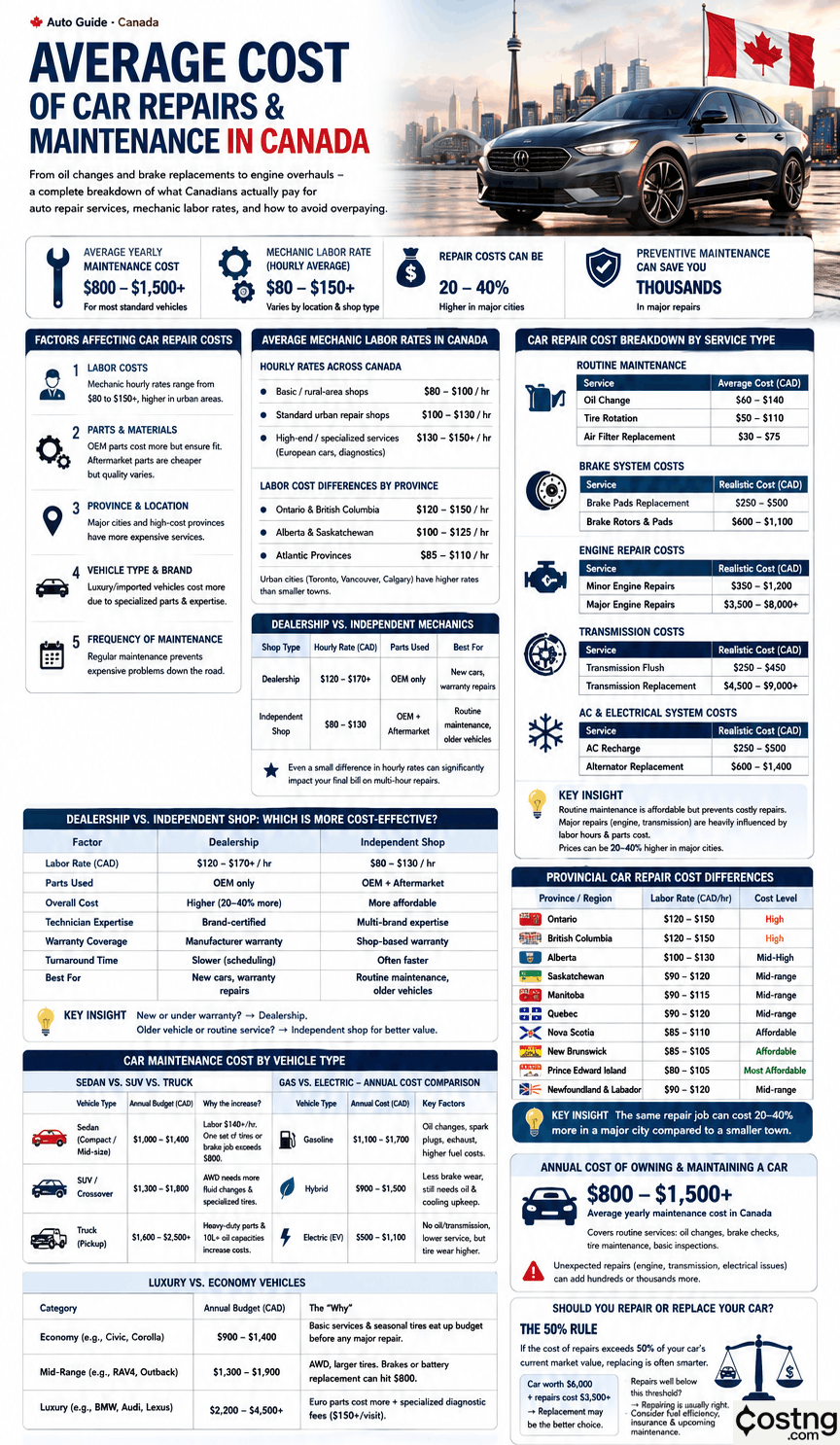
Understanding the cost of car repairs and maintenance in Canada is essential for every vehicle owner. Whether it's routine upkeep like oil changes and brake servicing or complex automotive repairs such as transmission or engine work, prices vary significantly based on labor rates, parts, region, and vehicle type.
Across provinces like Ontario, British Columbia, and Alberta and major cities like Toronto, Vancouver, and Calgary auto repair expenses differ due to local labor rates, demand, and parts availability. In this guide, we break down realistic price ranges, hourly labor rates, diagnostic fees, and the key factors that drive your final bill.
Overview of Car Repair Costs in Canada
Car repair and maintenance costs in Canada vary widely depending on vehicle type, driving habits, and location. On average, Canadian drivers spend between $800 and $1,500+ per year on routine maintenance and minor repairs covering oil changes, tire rotations, brake inspections, and fluid replacements.
However, this figure rises sharply when unexpected repairs arise, such as engine issues, transmission failures, or electrical problems.
Average Yearly Maintenance Cost
For most standard vehicles, annual maintenance costs remain predictable with regular servicing. Economy cars fall on the lower end of the spectrum, while SUVs, trucks, and luxury vehicles incur higher costs due to larger parts, more complex systems, and higher labor requirements. Older or high-mileage vehicles may also need more frequent servicing.
Core Factors Driving Automotive Repair Costs
To help visualize what influences your final invoice, the table below breaks down the primary cost contributors across Canada:
| Cost Driver | Canadian Market Impact | What to Expect |
|---|---|---|
| 1. Labor Rates | High Impact | Mechanic hourly rates range from $80 to $150/hr. Urban centers command the top end due to strict business overhead and wages. |
| 2. Parts Selection | Medium-High Impact | OEM (Original Equipment Manufacturer) parts offer exact fits but premium pricing. Aftermarket parts offer cost savings with variable quality. |
| 3. Geographic Location | Medium Impact | High cost-of-living provinces and major municipal hubs feature elevated rates. Rural towns offer lower baseline labor expenses. |
| 4. Vehicle Make & Class | High Impact | Luxury imports demand specialized software diagnostic tools and expensive components. Domestic economy models remain highly affordable. |
| 5. Maintenance Frequency | Preventative Impact | Consistent fluid checks and filter intervals cut down long-term failure rates. Neglect triggers highly volatile secondary damages. |
Average Mechanic Labor Rates in Canada
Labor is often the single largest variable on an automotive service receipt. In Canada, mechanic rates are deeply dependent on regional cost indexes, specialized tooling, and shop classification.
Hourly Labor Profiles by Tier and Region
The following data sets highlight the real-world scale of hourly automotive service charges calculated coast-to-coast:
| Shop Category / Region | Hourly Rate Range (CAD) | Operational Context |
|---|---|---|
| Basic & Rural Repair Shops | $80 – $100 / hr | Low regional overhead. Best for basic structural mechanical work, fluid updates, and older platforms. |
| Standard Urban Facilities | $100 – $130 / hr | Full general diagnostic setups. Positioned inside high-density neighborhoods with standard multi-vehicle tooling. |
| Specialized / High-End Service | $130 – $150+ / hr | Advanced electronic troubleshooting. Tailored for intricate European layouts and complex powertrain diagnostics. |
| Provincial Labor Rate Discrepancies | ||
| Ontario & British Columbia | $120 – $150 / hr | Driven by high real estate expenses and wage baselines across core cities (Toronto, Vancouver). |
| Alberta & Saskatchewan | $100 – $125 / hr | Balanced mid-range baseline service market, moving slightly higher within urban Calgary or Edmonton. |
| Atlantic Provinces | $85 – $110 / hr | Generally the lowest national operating index for standard commercial mechanic diagnostics. |
Alignment Profile: Dealership vs. Independent Mechanics
Where you bring your car radically alters your invoice totals. Below is an aligned structural lookup comparing both pathways side-by-side:
| Shop Model | Hourly Baseline | Parts Strategy | Optimal Scenario |
|---|---|---|---|
| Dealership | $120 – $170+ | Strictly OEM Components | New vehicles under factory coverage, complex recalls, or proprietary electronic updates. |
| Independent | $80 – $130 | OEM + Aftermarket Choices | Routine mileage maintenance, cost-effective aging vehicle upkeep, and structural mechanical tasks. |
Even minor variations in hourly shop rates compile rapidly across intensive assignments. A repair requiring five billable hours can fluctuate by hundreds of dollars on labor cost alone before hardware pricing is even introduced.
Car Repair Cost Breakdown by Service Type
The following detailed price charts reflect realistic Canadian market averages across distinct automotive service categories. Actual prices fluctuate depending on your specific vehicle type, exact geographic location, and local shop diagnostics.
Routine Maintenance Costs
These recurring services keep your vehicle running efficiently and help prevent catastrophic structural breakdowns.
| Service Type | Average Cost (CAD) | What's Included & Variables |
|---|---|---|
| Oil Change | $60 – $140 | Conventional engine oil is cheaper ($60-$80), while full synthetic fluids required for newer engines, trucks, or high-performance SUVs push the price to $100-$140. |
| Tire Rotation | $50 – $110 | Often bundled alongside seasonal winter/summer tire swaps for a discount. Standalone service run balances typically land around $60. |
| Air Filter Replacement | $30 – $75 | Premium high-performance filters or "cabin" air filters designed for interior climate control systems carry higher component pricing than standard engine filters. |
Brake System Costs
Brake components are highly critical for safety. Timely replacement prevents accidents and protects against high-cost rotor warping.
| Service Type | Average Cost (CAD) | What's Included & Variables |
|---|---|---|
| Brake Pads Replacement | $250 – $500 | Includes premium replacement pads per axle, fundamental shop labor, plus deep cleaning and lubricating of brake caliper slides. |
| Brake Rotors & Pads | $600 – $1,100 | Provides new compound pads, two matching brand-new rotors, system safety fluid checks, and complete mechanical labor installation. |
Engine Repair Costs
Engine repairs scale exponentially from swift component sensors to complex internal block overhauls depending on diagnostic trouble codes.
| Service Type | Average Cost (CAD) | What's Included & Variables |
|---|---|---|
| Minor Engine Repairs | $350 – $1,200 | Covers standard control sensors (such as O2 sensors or Mass Airflow / MAF sensors), fresh spark plug sets, or valve cover gasket swaps. |
| Major Engine Repairs | $3,500 – $8,000+ | Intensive procedures including blown head gaskets, timing chain alignment assemblies, or partial block engine rebuild mechanical work. |
Transmission Costs
Transmission work sits at the absolute top of auto repair expenses due to intense physical system complexity and extensive teardown time.
| Service Type | Average Cost (CAD) | What's Included & Variables |
|---|---|---|
| Transmission Flush | $250 – $450 | Full synthetic transmission fluid exchange, fresh internal filter swap (where applicable), and durable new pan seal gasket installation. |
| Transmission Replacement | $4,500 – $9,000+ | Complete assembly replacement. Modern fuel-efficient CVTs and heavy-duty 4x4 pickup truck transmissions routinely scale past $7,000. |
AC & Electrical System Costs
Modern vehicles feature intense networks of computers, and climate control failures are uniquely common under tough Canadian seasonal environments.
| Service Type | Average Cost (CAD) | What's Included & Variables |
|---|---|---|
| AC Recharge | $250 – $500 | Evacuation and fresh refrigerant fill (modern eco-friendly R1234yf formulas carry steep chemical premiums), leak dye testing, and vent profiling. |
| Alternator Replacement | $600 – $1,400 | Installation of a brand-new or certified remanufactured charging alternator plus complex layout labor (certain engines require 3+ hours of clearing access components). |
While basic routine updates remain highly affordable, major complex mechanical breakdowns are heavily calculated on pure labor hours and specialty import part pricing. Due to municipal overhead scales, overall costs trend 20% to 40% higher across major hubs like Toronto and Vancouver relative to rural communities.
Dealership vs. Independent Shop: Which Is More Cost-Effective?
Choosing the right mechanical facility requires balancing upfront cost against specialized vehicle knowledge. The comparative matrix below outlines how these two paths stack up across every core operational index:
| Evaluation Factor | Dealership Service Centers | Independent Repair Facilities |
|---|---|---|
| Labor Rate Range | $120 – $170+ / hr | $80 – $130 / hr |
| Parts Sourcing | Strictly OEM (Original Equipment Manufacturer) parts | Flexible blend of OEM and cost-saving Aftermarket parts |
| Pricing Overhead | Higher overall costs (typically 20% to 40% premium) | More affordable pricing tiers across labor and hardware |
| Technician Focus | Brand-certified specialists trained on specific makes | Multi-brand generalists with wide-ranging vehicle experience |
| Warranty System | Backed globally by the factory vehicle manufacturer | Backed locally by individual shop or banner networks |
| Turnaround Time | Can be slower due to strict booking lines and recall volumes | Often faster, offering highly flexible local scheduling |
If your vehicle is brand new or covered under a factory warranty program, a dealership center preserves your coverage and structural recall logs. For out-of-warranty platforms or basic wear-and-tear items, reputable independent shops deliver superior financial value without undercutting safety.
Car Maintenance Cost by Vehicle Type
A vehicle's physical blueprint radically shifts its maintenance needs. Larger platforms and heavy-duty drivetrains require expanded fluid capacities, heavy-duty suspension structures, and premium tire load indexes.
| Vehicle Blueprint Class | Realistic Annual Budget (CAD) | Core Mechanical Drivers |
|---|---|---|
| Sedan (Compact / Mid-Size) | $1,000 – $1,400 | Lighter platform strains suspension less. Lower fluid requirements and standard 15" to 17" tire replacements preserve budgets. |
| SUV / Crossover (CUV) | $1,300 – $1,800 | All-Wheel Drive (AWD) layouts mandate regular differential and transfer case fluid flushes alongside heavy-duty multi-link suspension wear. |
| Truck (Full-Size Pickup) | $1,600 – $2,500+ | Intense commercial-grade brake rotors, massive 8L to 12L oil sumps, and 4x4 mechanical transfer cases generate steep baseline fees. |
Gas vs. Electric Car Maintenance Costs in Canada
Powertrain architecture is the biggest modern differentiator in automotive upkeep. While high-voltage electric cars eliminate mechanical internal combustion assemblies, they shift wear dynamics directly onto electronic modules, high-load suspension components, and specialized tires.
| Powertrain Setup | Annual Cost Base (CAD) | Operational Dynamics & Wear Profile |
|---|---|---|
| ⛽ Internal Combustion (Gas) | $1,100 – $1,700 | Demands 2-3 oil changes yearly, regular spark plug cycles, engine air filters, drive belts, and complex mechanical exhaust monitoring updates. |
| ⚡ Hybrid Powertrains | $900 – $1,500 | Blends low brake pad wear (due to electric regenerative braking) with ongoing ICE maintenance profiles like engine oil and cooling system loops. |
| 🔌 Fully Electric (EV) | $500 – $1,100 | Eliminates spark plugs, engine oil, and transmission clutches. However, heavy vehicle mass accelerates tire and suspension bushing wear cycles. |
The Long-Term Financial Pivot Points
While fully electric vehicles secure clear annual cost victories on routine item lists, they remain vulnerable to high-cost secondary risk categories outlined below:
| Potential EV Cost Exposure | Real-World Canadian Market Context |
|---|---|
| Battery Pack Replacement | Highly rare under warranty periods, but structural failure out-of-warranty can match replacement fees of $8,000 to $20,000+. |
| Specialized Labor Bottlenecks | Fewer independent shops hold EV certification, often channeling owners back to premium dealership hourly diagnostic billing tracks. |
| Advanced Software Upkeep | Proprietary electrical bus frameworks require unique software diagnostic equipment subscriptions to resolve basic system resets. |
Powertrain Summary: Gas platforms offer low acquisition costs and universal repair access across any local Canadian shop, but pile on compounding fuel and fluid maintenance bills over time. EVs lower weekly costs but demand long-term attention to factory battery warranty dates.
When Should You Repair vs. Replace Your Car?
At some point, every vehicle owner faces a challenging financial crossroad: is it still logical to repair this vehicle, or is it time to replace it? The optimal answer lies in an objective evaluation of immediate repair bills against current asset valuations and recurring failure trends.
Miscalculating this point can drain thousands of dollars—either by over-investing in a rapidly depreciating vehicle or by prematurely upgrading a car that still had thousands of low-cost kilometers left to give.
The 50% Asset Evaluation Rule
The standard benchmark used throughout the automotive industry is simple: If a single mandatory repair estimate exceeds 50% of your vehicle's current fair market value, replacement is typically the more logical financial decision. This baseline protects you from pouring fresh capital into a asset nearing structural retirement.
| Current Vehicle Value | Immediate Repair Estimate | Financial Recommendation |
|---|---|---|
| $6,000 | $3,500+ | Replace: Repair cost exceeds the 50% threshold. Capital is better allocated toward a newer vehicle asset. |
| $10,000 | $2,000 | Repair: Bill sits safely below asset value parameters. Platform remains economically viable to maintain. |
| $4,000 | $2,500 | Borderline Scenario: Look closely at mileage and recent updates. If secondary issues loom, prioritize replacement. |
Strategic Decision Framework
Beyond raw numbers, true cost calculation requires analyzing immediate vs. long-term maintenance horizons. The blueprint below contrasts when to proceed with repairs against when to step away:
| When Repairing Makes Financial Sense | When Replacing Is the Better Option |
|---|---|
|
|
Even if an isolated fix appears manageable, map out secondary issues likely to arise over the next 6 to 12 months. Investing $1,500 today to resolve a cooling issue, only to face a $2,000 suspension overhaul next season, quickly destroys the financial logic of holding onto an aging car.
How to Reduce Car Repair Costs in Canada
While component failures and operational wear are inevitable aspects of vehicle ownership, the total amount you end up paying is highly manageable. Adopting structured maintenance frameworks can cut long-term automotive expenses by thousands of dollars.
| Savings Core Strategy | Actionable Execution Steps | Estimated Cost Benefit |
|---|---|---|
| 1. Preventative Maintenance Cycles | Strictly stick to standard oil change intervals, inspect fluid levels before winter shifts, and monitor brake wear levels proactively. | Reduces lifetime costs by 30% – 50% |
| 2. Itemized Estimate Verification | Always collect 2–3 competing quotes for extensive repairs. Request clear line-item splits separating labor hour calculations from component parts. | Eliminates 15% – 25% in shop markup |
| 3. Strategic Aftermarket Selection | Deploy trusted aftermarket components for high-wear structural items (pads, filters, links). Rely on OEM components for sensitive engine modules. | Saves 20% – 40% on hardware prices |
| 4. Focused DIY Tasks | Handle baseline, non-critical components directly at home: swap engine and interior cabin air filters, install wiper blades, or refresh old batteries. | Completely removes billable shop labor |
| 5. Relationship Building | Form a long-term partnership with one highly-rated, local independent shop. Loyal client portfolios secure honest prioritization and diagnostic breaks. | Prevents upsells & phantom repairs |
“A highly skilled mechanic doesn’t just patch over your immediate technical failures—they partner with you to safely map out and prevent your next major breakdown.”
Ignoring minor early symptoms like strange engine compartment noises, dashboard indicator lights, or subtle steering wheel vibrations is a fast track to severe failure. An overlooked $150 oil leak can rapidly starved an internal assembly, generating a $5,000 repair bill that could have been avoided entirely.
When Should You Repair vs. Replace Your Car?
Deciding whether to repair or replace a vehicle requires a clear cost-benefit analysis of ongoing repair expenses versus the value and remaining lifespan of the car.
Cost-Benefit Analysis
- If repairs are occasional and affordable, keeping the car is usually better.
- If repairs are frequent and unpredictable, costs can quickly exceed the car's value.
- Consider long-term costs: fuel efficiency, insurance, and upcoming maintenance needs.
A practical rule is to evaluate whether the car will remain reliable for at least another 1–2 years after the repair.
The 50% Rule of Vehicle Value
If the cost of repairs exceeds 50% of your car's current market value, replacing the vehicle is often the better financial decision.
- If your car is worth $6,000 and repairs cost $3,500+, replacement may be more economical.
- If repairs are well below this threshold and the car is otherwise in good condition, repairing is usually the smarter choice.
| Car Value | Repair Cost | Recommendation |
|---|---|---|
| $6,000 | $3,500+ | Replace the vehicle |
| $10,000 | $2,000 | Repair is reasonable |
| $4,000 | $2,500 | Borderline — consider replacement |
When Repairing Makes Sense
- The vehicle is otherwise reliable
- The repair is a one-time issue (not recurring)
- The car has low mileage
- You’ve recently invested in maintenance (tires, brakes, etc.)
When Replacing Is the Better Option
- Frequent breakdowns and unpredictable issues
- Major systems failing (engine, transmission, electrical)
- Repair costs approaching or exceeding vehicle value
- Safety concerns or structural damage
Pro Tip: Even if a repair seems affordable, consider whether additional repairs are likely within the next 6–12 months. Multiple smaller repairs can quickly exceed the value of an older vehicle.
Tips to Reduce Car Repair Costs in Canada
Reducing car repair expenses is mainly about preventing major issues and making smarter service decisions.
Preventive Maintenance
Routine servicing is the most effective way to reduce long-term costs.
- Regular oil changes prevent engine wear
- Brake inspections prevent costly rotor damage
- Fluid checks prevent overheating and failures
Preventive maintenance can reduce long-term repair costs by up to 30–50%.
Compare Quotes from Multiple Shops
- Get estimates from at least 2–3 mechanics
- Ask for itemized breakdowns
- Compare labor rates and parts pricing
Use Aftermarket Parts Where Appropriate
Aftermarket parts are often significantly cheaper than OEM parts.
- Best for: filters, brakes, suspension components
- Use OEM for: electronics, sensors, complex systems
DIY Simple Maintenance Tasks
Many small maintenance jobs can be done at home:
- Replacing air filters
- Installing wiper blades
- Changing batteries
- Topping up fluids
Avoid Emergency Repairs
Emergency situations often lead to higher costs due to urgency and limited options.
- Towing fees: $100–$250+
- Higher repair premiums
- Limited ability to compare prices
Warning: Ignoring small issues like warning lights, noises, or vibrations often leads to much more expensive repairs later.
Frequently Asked Questions
Car repairs are expensive due to high labor rates, costly parts, and regional overhead costs. Labor alone ranges from $80 to $150+ per hour, and imported parts increase total repair costs significantly.
Dealerships are typically more expensive than independent shops. However, they are recommended for warranty repairs and brand-specific diagnostics.
Most Canadians should budget between $800 and $1,500+ annually for routine maintenance, excluding major repairs.
Engine and transmission replacements are the most expensive repairs, often costing between $3,000 and $9,000+ depending on the vehicle.
Yes, EVs generally have lower maintenance costs because they have fewer moving parts and do not require oil changes. However, battery replacement can be expensive outside warranty coverage.
Final Thoughts: Understanding Car Repair Costs in Canada
Car repair and maintenance costs in Canada vary widely, but understanding the key factors—labor rates, parts, vehicle type, and location—helps you make better financial decisions.
Routine maintenance is relatively affordable, but major repairs like engine or transmission work can quickly reach thousands of dollars. Staying proactive is the best way to control costs.
Key Takeaways:
- Average yearly maintenance: $800–$1,500+
- Labor rates: $80–$150+ per hour
- Major repairs can exceed $5,000+
- Independent shops usually offer better value
- Preventive maintenance saves the most money long-term
By staying informed and maintaining your vehicle properly, you can significantly reduce long-term ownership costs and avoid unexpected financial stress.